ACL Repair vs. ACL Reconstruction — Which Arthroscopic Option Is Right for You?
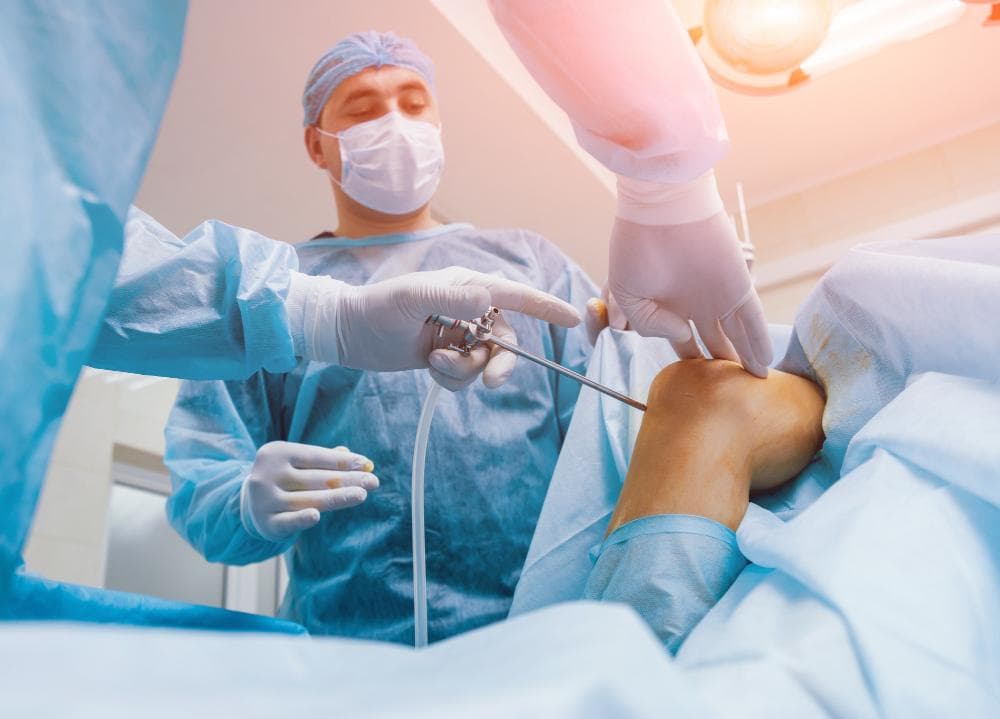
A medical team is in an operating room, focusing on a knee arthroscopic procedure. The patient’s knee is covered with sterile drapes, and bright surgical lights illuminate the scene.
The ACL — anterior cruciate ligament — is one of the four main ligaments that stabilise the knee. It runs diagonally through the middle of the joint, connecting the femur (thigh bone) to the tibia (shin bone) and preventing the tibia from sliding forward under the femur. When it tears, the knee often gives way during cutting, pivoting, or landing movements. For athletes and active individuals, it is one of the most career-altering injuries in sports.
For decades, the treatment for a complete ACL tear was clear: reconstruction. Take the torn ligament out, harvest a graft (from the patient's own hamstring or patellar tendon, or from a donor), and build a new ligament. The science behind reconstruction is mature, the outcomes are well documented, and return-to-sport rates are consistently good.
Then repair re-entered the conversation. Better techniques, better materials, and a growing body of evidence showing that, for specific tear types and specific patients, repairing the torn ACL — rather than replacing it — produces comparable outcomes with meaningful advantages. It is not a universal alternative to reconstruction, but it is a genuine option in the right hands for the right patient.
This article explains both procedures, how they differ, who is appropriate for each, and what recovery looks like.
What Is ACL Reconstruction?
ACL reconstruction is the gold standard treatment for complete ACL tears in active individuals. The torn ligament is removed arthroscopically and replaced with a graft — a tendon harvested from another part of the body or from a donor.
Graft options:
Hamstring autograft — Tendons from the back of the patient's own thigh (semitendinosus and gracilis). Most commonly used in India and globally. Good strength, relatively low donor-site morbidity.
Patellar tendon autograft (BTB — bone-tendon-bone) — The central third of the patellar tendon, with bone blocks at each end that anchor into bone tunnels. Historically the strongest option. More donor-site pain than hamstring grafts. Often preferred for high-level athletes.
Quadriceps tendon autograft — Increasingly popular, particularly for revision cases or when other graft sites are not available.
Allograft — Graft from a cadaver donor. No donor-site morbidity. Generally not preferred for younger active patients due to slower biological incorporation and slightly higher retear rates.
The graft is tunnelled through bone tunnels drilled at the original ACL attachment sites and held in place with fixation devices while it gradually incorporates and becomes a functioning ligament over months.
What Is ACL Repair?
ACL repair is not the same as the old "primary repair" technique from the 1980s, which had poor outcomes and was largely abandoned. Modern ACL repair uses two newer approaches:
Dynamic Intraligamentary Stabilisation (DIS) — An internal brace (suture tape) is placed alongside the repaired ACL to protect it while it heals. The repaired ligament heals in its native position, supported by the brace.
Bridge-Enhanced ACL Repair (BEAR) — A sponge-like scaffold saturated with the patient's own blood is implanted at the tear site. The scaffold bridges the gap in the torn ACL, allowing the patient's own healing response to regenerate the ligament. This technique has shown very promising results in early trials.
Both approaches are done arthroscopically. The key principle is that the torn ACL is not removed — it is reattached and allowed to heal with structural support.
The Critical Difference: Who Qualifies for Repair
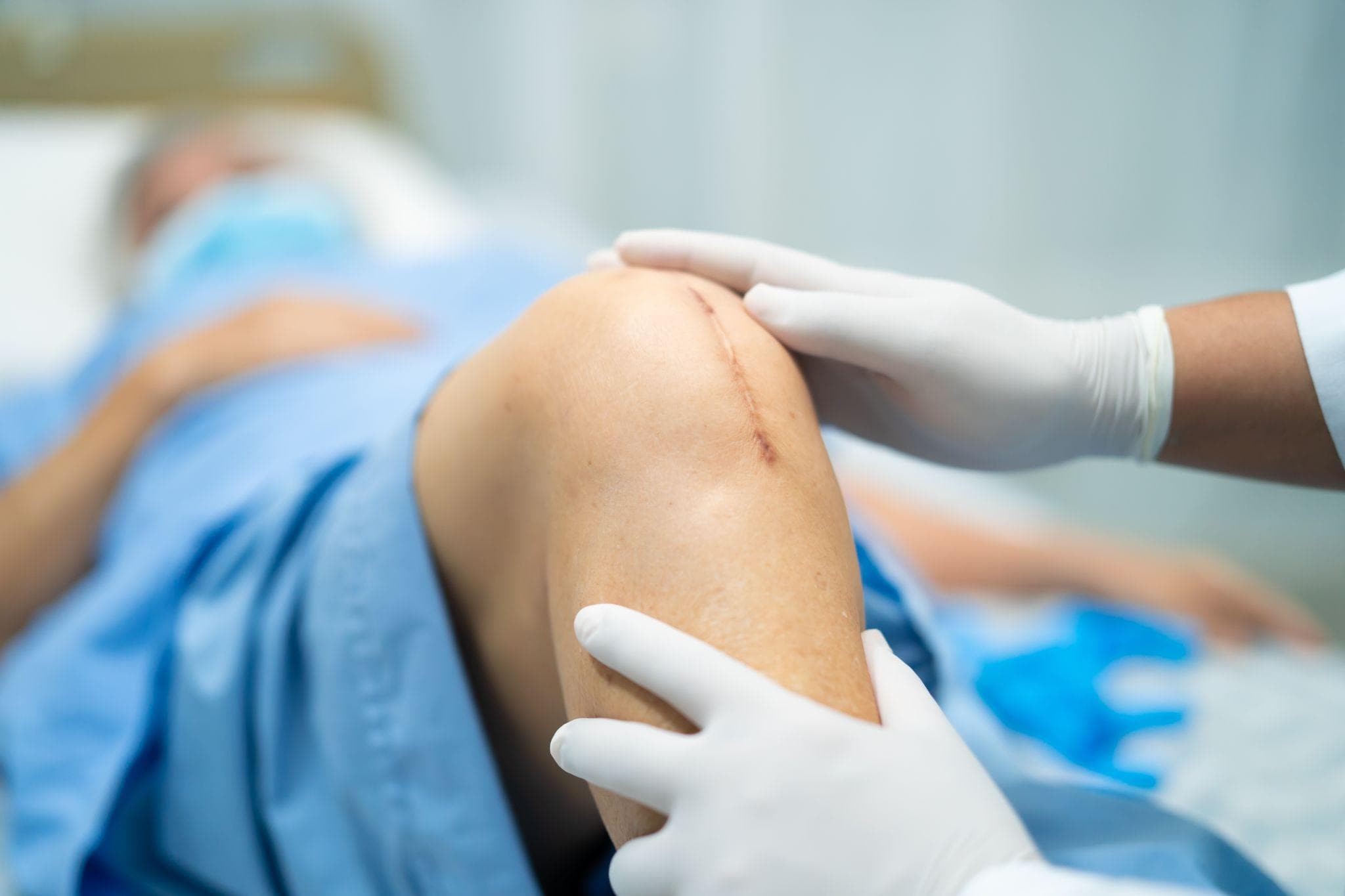
A healthcare professional examining a knee after total knee replacement surgery during recovery.
ACL repair is not appropriate for every ACL tear. The tear location and the condition of the remaining ligament tissue are the determining factors.
ACL repair works for:
- Proximal tears — tears that occur near the femoral attachment (the upper end of the ligament, where it connects to the thigh bone). These tears have sufficient blood supply and viable tissue to heal if supported.
- Fresh injuries — repair is most effective within the first 2–3 weeks. The tissue is still healthy and the biological environment supports healing.
- Good tissue quality — in younger patients with a structurally intact but proximally torn ACL.
ACL repair does NOT work for:
- Midsubstance tears — tears in the middle of the ligament. This tissue does not receive adequate blood supply and has poor healing potential. Repair fails in these cases.
- Chronic, old tears — ligament tissue that has been torn for weeks or months degrades significantly. Repair is not viable.
- Complete degenerative or frayed ligaments — there is nothing to repair if the tissue quality is poor.
- Paediatric patients with open growth plates — where standard graft tunnels would cross growth plates, repair may be technically more appropriate, but this is complex and case-specific.
ACL Repair vs. Reconstruction: The Evidence
The evidence comparing modern ACL repair to reconstruction is still developing, but the picture is becoming clearer:
For proximal tears, repair shows comparable outcomes to reconstruction in terms of knee stability, patient-reported function, and return-to-sport rates — in carefully selected patients, at 2-year follow-up. Some studies show better hamstring strength preservation after repair (because the hamstring graft is not harvested).
Reconstruction has a longer proven track record at 5–10 years. The BEAR technique specifically has encouraging 2-year data, with clinical trials ongoing at 5 years.
Repair has a slightly higher retear rate than reconstruction in some studies — though modern internal brace techniques are improving these numbers. The DIS approach with suture tape augmentation appears to address this concern meaningfully.
Reconstruction remains the gold standard for most complete ACL tears, particularly midsubstance tears, chronic tears, and in high-level athletes where the retear risk is a critical concern.
Graft Selection for Reconstruction: What Matters
When reconstruction is indicated, graft selection involves:
Patient age — Younger, more active patients generally do better with autograft (their own tissue). Allografts are sometimes appropriate for recreational athletes over 45.
Activity level and sport demands — High-level athletes in cutting sports often do better with bone-tendon-bone patellar tendon graft (higher early stiffness, faster initial strength) or quadriceps tendon.
Prior surgeries — If the hamstrings were previously used or if there is significant prior surgery around the knee, graft options may be limited.
Bilateral injuries — In cases where both knees need reconstruction, graft planning requires careful consideration of harvest sites.
Recovery: Repair vs. Reconstruction
This is where the two approaches differ most meaningfully for patients:
ACL Repair Recovery:
- Weight-bearing permitted earlier (sometimes immediately, with brace)
- Return to running at 3–4 months (faster than reconstruction in most protocols)
- Return to sport: 4–6 months (significantly faster than reconstruction)
- Rehabilitation is accelerated but still requires careful progression
ACL Reconstruction Recovery:
- Crutches for 2–4 weeks
- Full weight-bearing at 4–6 weeks (varies by graft type and fixation)
- Return to running at 3–4 months
- Return to sport (cutting/pivoting): 9–12 months, with return-to-sport testing
- The graft undergoes a biological process called ligamentisation — becoming a ligament — which takes 12–18 months to complete
The faster return-to-sport with repair is one of its most appealing aspects for athletes. However, not all ACL tears qualify for repair, and using repair in the wrong patient (midsubstance tear, old injury) is not an option — the tissue will not heal.
What Dr. Akash Dubey Recommends
At Your Bone Mechanic clinic in Gaur City 2, Greater Noida West, Dr. Akash Dubey holds a Fellowship in Arthroscopy and Sports Surgery (FIAS) and manages ACL injuries across the full spectrum — from acute proximal tears where repair may be appropriate to chronic midsubstance tears requiring reconstruction.
His approach: assess the imaging (MRI is essential), evaluate the tear pattern and location, understand the patient's activity level and timeline, and then explain both options honestly where both are on the table. For most patients presenting with a complete ACL tear, reconstruction will be recommended — it is the more reliable option with the longer evidence base. For specific proximal tears in appropriate patients presenting early, repair is a conversation worth having.
The FIFA Diploma in Football Medicine that Dr. Dubey holds reflects his specific training in sports medicine and athlete care — relevant for the many cricket players, footballers, and active young adults in Greater Noida and Noida NCR who sustain ACL injuries in sport.
Frequently Asked Questions
Q: Can an ACL tear heal without surgery?
A partial ACL tear with minimal instability may be managed non-surgically with physiotherapy and bracing in some patients — particularly older, less active individuals. A complete tear in an active person wanting to return to sport generally needs surgery.
Q: What is the success rate of ACL reconstruction?
Return-to-sport rates after ACL reconstruction are approximately 80–85% in most studies. About 15% of patients, particularly high-level athletes returning to cutting sports, experience a retear. Rehabilitation compliance and return-to-sport testing are major factors.
Q: Is ACL surgery available in Greater Noida?
Yes. Dr. Akash Dubey performs arthroscopic ACL reconstruction at KDSG Superspeciality Hospital, Greater Noida.
Q: How soon after an ACL tear should surgery happen?
For reconstruction, there is no emergency window — most surgeons prefer to wait 3–6 weeks for swelling to resolve and quadriceps function to return before operating, as this reduces the risk of post-operative stiffness. For repair, earlier is better — ideally within 2–3 weeks.
Q: Can I play cricket or football again after ACL reconstruction?
Yes. With a proper 9–12 month rehabilitation programme, including return-to-sport testing, the majority of patients return to their sport at or near their previous level.
Contact Dr. Akash Dubey — Your Bone Mechanic
Dr. Akash Dubey
MBBS (KGMU, Lucknow) | MS | DNB Ortho | FIAS | FIJR | FIFA Diploma in Football Medicine
Robotic Surgery Certified | Member, AOPAS
Clinic: Shop No. 24, Ground Floor, Gaur City Arcade, Near Sarvodaya Hospital, Gaur City 2, Greater Noida West, U.P. – 201301
To book a consultation for ACL injury in Greater Noida, call +91-8130441429