Arthroscopy for Sports Injuries: How Athletes Get Back on the Field Faster
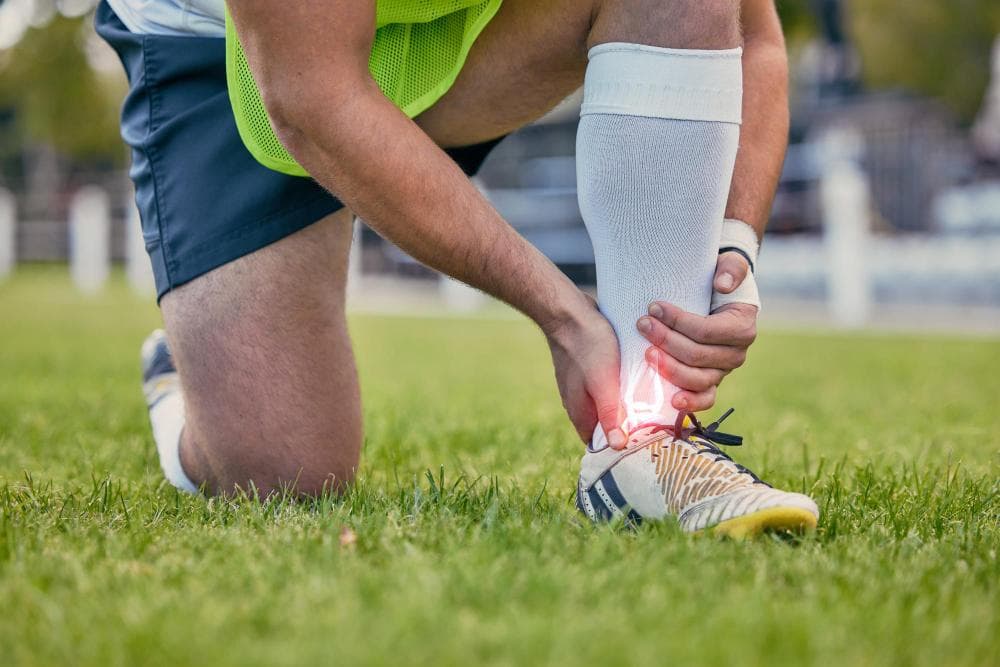
A male soccer player kneels on the grass, gripping his ankle with both hands and showing a pained expression. The area around his ankle is highlighted in red, indicating injury. The background features a blurred field and goalposts.
In sport, an injury means time off. For a club cricketer, that might mean missing a few matches. For a serious athlete, it can mean months away from the game they have built their fitness, their identity, and sometimes their livelihood around. The question they ask is not just "what is wrong?" — it is "how quickly can I get back, and how do I make sure I come back at my previous level?"
Arthroscopy changed the calculus for joint injuries in athletes significantly. Before keyhole surgery was available, treating a torn meniscus or a damaged knee cartilage meant opening the joint completely — a much larger recovery. Arthroscopy gave surgeons the ability to address the same problems through incisions smaller than a centimetre, reducing surgical trauma and shortening the path back to play.
But "faster" does not mean "rushed." The joint structures that arthroscopy repairs — ligaments, cartilage, labrum — have biological healing timelines that cannot be compressed beyond certain limits. This article covers what arthroscopy can do for common sports injuries, realistic return-to-sport timelines, and what athletes need to understand about the recovery process.
The Most Common Sports Injuries Treated with Arthroscopy
1. ACL Tears
The ACL (anterior cruciate ligament) is the most discussed sports injury globally. It is torn most frequently in sports involving sudden changes of direction, deceleration, or landing — football, cricket, basketball, kabaddi, badminton.
ACL reconstruction via arthroscopy — using the patient's own hamstring or patellar tendon — is the standard treatment for complete tears in athletes wanting to return to cutting sports. Arthroscopy allows the graft to be placed precisely through bone tunnels with minimal disruption to surrounding structures.
Return to sport after ACL reconstruction: 9–12 months. No exceptions for high-level athletes returning to cutting or contact sports.
2. Meniscal Tears
Twisting injuries during sport frequently cause meniscal tears. The meniscus can split lengthwise (longitudinal tear), flip inward (bucket-handle tear, causing locking), or develop flaps of unstable tissue that catch and cause pain.
Arthroscopy treats these in two ways: meniscal repair (stitching the tear) or partial meniscectomy (trimming the damaged tissue). Repair is preferred in younger athletes where the tear is in the vascular zone and the tissue quality is good. It protects the knee long-term.
Return to sport after meniscectomy: 4–8 weeks. After meniscal repair: 4–6 months.
3. Shoulder Instability (Bankart Repair)
In collision and overhead sports — wrestling, boxing, volleyball, cricket (bowling) — shoulder dislocations are a real risk. Once the shoulder has dislocated, recurrence rates in young athletes are very high (up to 90% in some studies for athletes under 25 in contact sports).
Arthroscopic Bankart repair — reattaching the torn labrum with suture anchors — is the standard surgical treatment after a first or recurrent dislocation in athletes who want to return to sport. It significantly reduces the risk of further instability.
Return to sport after Bankart repair: 5–6 months for non-contact sport; 6–9 months for full contact sport.
4. Rotator Cuff Tears in Overhead Athletes
Cricketers, swimmers, overhead racquet sport players — these athletes place enormous repetitive demand on the rotator cuff. Partial tears from chronic overuse, and full-thickness tears from acute trauma or progressive degeneration, are all amenable to arthroscopic repair.
Return to overhead sport after arthroscopic rotator cuff repair: 6–12 months depending on tear size and repair quality.
5. Loose Bodies and Osteochondral Injuries
An acute impact during sport can dislodge a fragment of cartilage or bone, creating a loose body inside the joint. These cause locking, catching, and sharp pain. Arthroscopy removes them quickly and effectively, with fast recovery.
Return to sport after loose body removal: 2–6 weeks depending on size and any associated cartilage repair.
6. Hip Impingement in Athletes
FAI (femoroacetabular impingement) is increasingly recognised in elite sport. The cam or pincer bone shape causes labral damage with repeated hip flexion — common in football, martial arts, gymnastics, and cycling.
Arthroscopic FAI correction and labral repair produces good return-to-sport outcomes in well-selected athletes.
Return to sport after hip arthroscopy for FAI: 4–6 months.
What Athletes Need to Understand About Arthroscopy

An athlete with a knee injury, illustrating the need for expert care after sports injuries or sudden joint pain.
1. Arthroscopy Is the Procedure. Rehabilitation Is the Recovery.
The surgery creates the anatomical conditions for return to sport. Rehabilitation is what actually gets the athlete back. Quadriceps strength, hamstring strength, proprioception, confidence, sport-specific movement patterns — none of these come from the procedure. They come from 5–9 months of consistent, well-supervised rehabilitation.
Athletes who treat rehabilitation as a formality — doing the minimum sessions, skipping exercises, rushing return to sport — have worse outcomes, higher complication rates, and significantly higher retear rates. This is one of the most consistent findings in sports medicine.
2. Return-to-Sport Testing, Not Return-to-Sport Calendar
The biggest shift in sports injury rehabilitation in the past decade has been moving away from calendar-based return to sport toward criteria-based return. A player does not return to cricket at 9 months just because it has been 9 months. They return when:
- Quadriceps and hamstring strength are within 10% of the opposite leg (limb symmetry index)
- Hop tests (single leg, triple hop, crossover hop) show adequate power and confidence
- Sport-specific agility tests are passed
- Psychological readiness is assessed — fear of reinjury has been shown to predict a higher retear rate independent of physical strength
Dr. Akash Dubey's approach incorporates these principles. His FIFA Diploma in Football Medicine reflects specific training in sports injury management and athlete return-to-sport decision-making.
3. Bilateral Injuries Are Possible
An ACL reconstruction does not make the other knee invulnerable. The risk of tearing the opposite ACL in the 12 months after returning to sport is actually elevated — partly from compensating movement patterns during recovery. A full rehabilitation programme that addresses both limbs reduces this risk.
For Cricketers, Footballers, and Athletes in Noida NCR
The NCR region has a substantial population of active sportspeople — club cricketers, football players at local and state level, amateur marathon runners, badminton enthusiasts, and gym athletes. These are Dr. Akash Dubey's patients.
The combination of FIAS (Fellowship in Arthroscopy and Sports Surgery), FIFA Diploma in Football Medicine, and experience treating athletes across Greater Noida and surrounding areas means patients get sport-specific counselling alongside their surgical care. The question is not just "has the knee healed?" but "is this athlete ready to go back to their sport, at their level, safely?"
Frequently Asked Questions
Q: How soon after a sports injury should I see an arthroscopy specialist?
For significant injuries — particularly suspected ACL tears or locked knees — within the first week. Early assessment does not necessarily mean early surgery, but it prevents delayed diagnosis and allows proper planning.
Q: Can I play again after ACL reconstruction in Greater Noida?
Yes. The majority of patients — with proper rehabilitation — return to their sport at or close to their previous level. Return to competitive sport is at 9–12 months with criteria-based assessment.
Q: Do I need arthroscopy for a partial ACL tear?
Not always. Many partial ACL tears — particularly those where the knee remains stable — respond to physiotherapy, bracing, and activity modification. The degree of instability and the patient's activity goals guide the decision.
Q: Does Dr. Akash Dubey treat sports injuries in Greater Noida?
Yes. With FIAS credentials, a FIFA Diploma in Football Medicine, and a dedicated sports injury focus at Your Bone Mechanic clinic, Dr. Dubey manages the full spectrum of sports joint injuries from diagnosis through surgery and return-to-play.
Contact Dr. Akash Dubey — Your Bone Mechanic
Dr. Akash Dubey
MBBS (KGMU, Lucknow) | MS | DNB Ortho | FIAS | FIJR | FIFA Diploma in Football Medicine
Robotic Surgery Certified | Member, AOPAS
Clinic: Shop No. 24, Ground Floor, Gaur City Arcade, Near Sarvodaya Hospital, Gaur City 2, Greater Noida West, U.P. – 201301
To book a sports injury consultation in Greater Noida, call +91-8130441429