FIFA Diploma in Football Medicine: What It Means for Footballers Seeking Orthopaedic Care
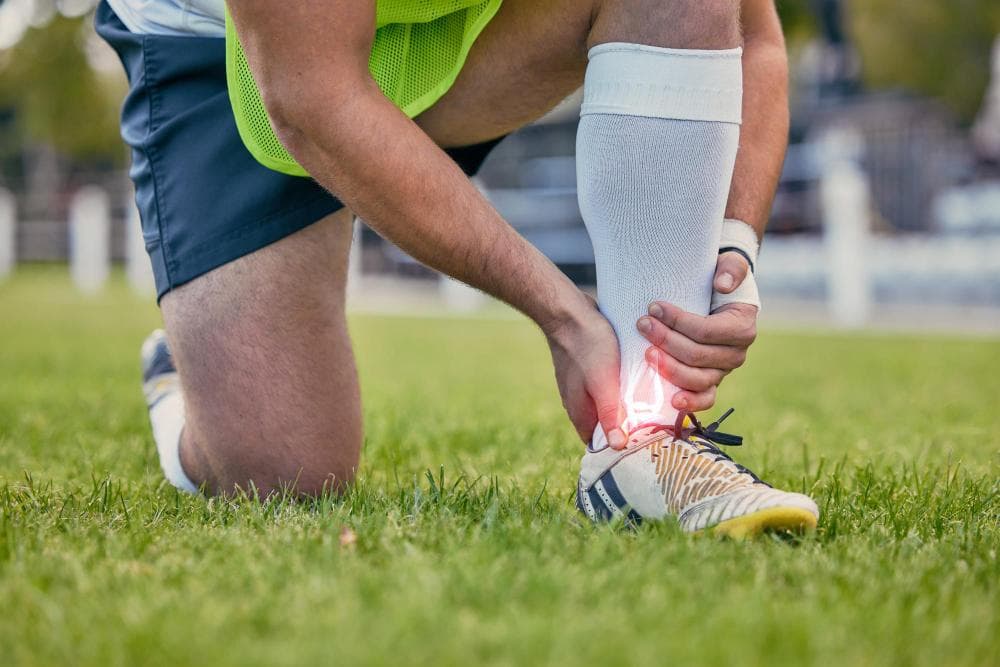
A male soccer player kneels on the grass, gripping his ankle with both hands and showing a pained expression. The area around his ankle is highlighted in red, indicating injury. The background features a blurred field and goalposts.
Among the credentials listed alongside Dr. Akash Dubey's name — MBBS (KGMU), MS, DNB Ortho, FIAS, FIJR — one stands out as distinctly sports-specific: the FIFA Diploma in Football Medicine. For patients who are footballers, recreational or serious, this credential deserves an explanation. What does it actually mean? Who developed it? What does a doctor with this diploma know that one without it does not?
What Is the FIFA Diploma in Football Medicine?
FIFA — the Fédération Internationale de Football Association, the global governing body for football — launched its Diploma in Football Medicine in 2016 through its Medical Assessment and Research Centre (F-MARC). The programme was designed to raise the standard of medical care for football players at every level globally — from elite clubs to grassroots participants.
The diploma covers 42 modules, each written by internationally recognised sports medicine experts affiliated with FIFA Medical Centres of Excellence. The scope is comprehensive:
Musculoskeletal injuries — Joint-specific content for the ankle, knee, hip, shoulder, and elbow; injury-specific content for ACL ruptures, meniscal tears, groin injuries, hamstring strains, and bone stress injuries.
Medical conditions in football — Cardiac screening in athletes, sudden cardiac arrest management, concussion diagnosis and protocols, diabetes in athletes, dermatological conditions, and heat illness management.
Specific football contexts — Travel medicine for teams, doping and anti-doping in football, female athlete health, injury prevention programmes (including the FIFA 11+ injury prevention protocol).
Rehabilitation principles — Return-to-play protocols, rehabilitation exercises specific to common football injuries, psychological aspects of injury and recovery.
The programme is delivered online and was designed to be accessible to clinicians worldwide — a deliberate decision by FIFA to globalise the standard of player care. As of 2017, nearly 25,000 clinicians had registered from virtually every country, with India among the top five most represented nations.
What the FIFA 11+ Means for Injury Prevention
One of the most practically significant aspects of the FIFA diploma is its comprehensive coverage of the FIFA 11+ programme — an evidence-based injury prevention warm-up designed by F-MARC.
The FIFA 11+ replaces a standard warm-up with a structured 20-minute programme that includes:
- Running drills (jogging, planting, cutting)
- Strengthening exercises (single-leg squats, Nordic hamstring curls, hip and core work)
- Balance and proprioception exercises
Research shows that consistent use of the FIFA 11+ reduces overall injury rates by approximately 35–50% in community and youth football. For knee ligament injuries specifically — including ACL tears — the reduction is even more pronounced.
Dr. Akash Dubey's training in these protocols means that football teams and players in Greater Noida and Noida NCR who work with him have access not just to injury treatment but to structured injury prevention guidance.
What a Doctor with the FIFA Diploma Understands About Football-Specific Injuries
Football is not just "sport." It has specific injury epidemiology, specific physiological demands, and specific return-to-play considerations that are different from cricket, badminton, or running.
1. Common Football Injuries and Football-Specific Nuances
Hamstring strains — The most common injury in football globally, accounting for approximately 12% of all football injuries. They occur predominantly during maximal sprinting in the late swing phase. Return-to-play after hamstring injury requires football-specific sprint testing and movement quality assessment — not just absence of pain.
Groin/adductor injuries — Adductor-related groin pain (previously called "groin strain") is the second most common football injury. The management involves distinguishing between adductor-related, iliopsoas-related, inguinal-related, and pubic-related groin pain — each with different rehabilitation and different timelines. Understanding this distinction requires specific training.
Ankle sprains — Extremely common in football, with a high recurrence rate if not properly rehabilitated. Chronic lateral ankle instability is disproportionately prevalent in footballers due to repeated sprains that were inadequately managed.
Knee ligament injuries — The knee takes enormous rotational and contact forces in football. ACL injuries in female footballers have received significant research attention due to the 3–4 times higher incidence compared to male players — related to differences in biomechanics, hormonal factors, and training history.
Head injuries and concussion — Football involves headers and accidental head contacts. Concussion recognition and management in football is a mandatory competency in the diploma. The FIFA Return to Play protocol for concussion is covered in detail — a standard that community football in India often lacks consistent access to.
2. Return-to-Play Decision Making in Football
The FIFA diploma trains clinicians in the process of sports-specific return-to-play assessment — not just whether the injury has healed, but whether the player's physical capacity, movement patterns, and psychological readiness meet the demands of football competition.
For a footballer returning after ACL reconstruction, this means:
- Assessing sprint mechanics, not just walking
- Testing change-of-direction ability at speed, not just linear running
- Evaluating psychological readiness — is the player attacking the ball or avoiding contact?
- Communicating with the player's club or coach about the appropriate return stage
This sports-specific approach is not something every orthopaedic surgeon brings to the table. Dr. Akash Dubey's FIFA diploma reflects specific training in this domain.
What This Means for Football Players in Greater Noida and Noida NCR
Football in the NCR is growing. Local clubs, academy setups, college teams, and recreational leagues are all part of a landscape where players sustain the full range of football injuries — from ankle sprains to ACL tears to groin injuries — and often seek care from general practitioners or non-specialist orthopaedic surgeons who may not be familiar with football-specific return-to-play considerations.
Dr. Akash Dubey's practice at Your Bone Mechanic clinic in Gaur City 2, Greater Noida West combines the structural diagnosis and surgical capabilities of an orthopaedic specialist (MBBS, MS, DNB Ortho, FIAS) with the sports-specific knowledge of a FIFA diploma holder. This combination is relevant for:
- Academy footballers and college players who sustain joint injuries and want to return to football at their competitive level, not just to general daily activity
- Recreational players who want to understand their injury, their options, and their realistic return-to-play timeline in the context of football
- Club coaches and team managers who want access to an orthopaedic resource familiar with football-specific injury prevention and management
- Parents of young footballers whose children have sustained knee or ankle injuries and want guidance from a specialist with specific football medicine knowledge
Frequently Asked Questions
Q1: What does the FIFA Diploma cover that a standard orthopaedic degree does not?
The FIFA diploma specifically covers football injury epidemiology, football-specific return-to-play protocols, the FIFA 11+ injury prevention programme, concussion management in football, and the specific musculoskeletal demands of the sport. These are not typically covered in depth in standard orthopaedic training.
Q2: Does Dr. Akash Dubey treat non-football athletes too?
Yes. The FIFA diploma is one part of Dr. Dubey's sports medicine training — the FIAS (Fellowship in Arthroscopy and Sports Surgery) covers sports injuries broadly. He treats athletes across cricket, badminton, athletics, martial arts, gym sports, and all recreational sports.
Q3: Can the FIFA 11+ be implemented by clubs in Greater Noida?
Yes. Dr. Akash Dubey can provide guidance on implementing structured injury prevention warm-up programmes for football clubs in the Greater Noida area. The FIFA 11+ is evidence-based, requires no equipment, and takes approximately 20 minutes to complete.
Contact Dr. Akash Dubey — Your Bone Mechanic
Dr. Akash Dubey
MBBS (KGMU, Lucknow) | MS | DNB Ortho | FIAS | FIJR | FIFA Diploma in Football Medicine
Robotic Surgery Certified | Member, AOPAS
Clinic: Shop No. 24, Ground Floor, Gaur City Arcade, Near Sarvodaya Hospital, Gaur City 2, Greater Noida West, U.P. – 201301
To book a sports injury consultation in Greater Noida, call +91-8130441429