How Long Does a Knee Replacement Last? Honest Answers for Patients in Greater Noida
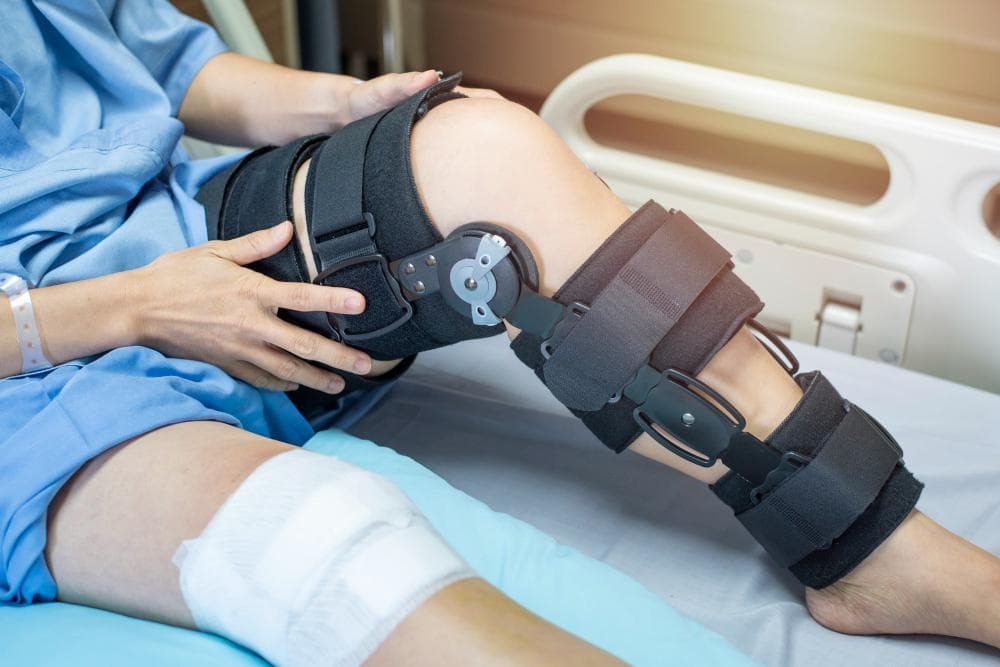
A patient is lying down in the hospital room post-surgery and is wearing a knee brace for proper recovery.
This is one of the first questions every knee replacement patient asks — and rightly so. You are about to have major surgery, spend months recovering, and live with an artificial joint. Knowing how long that investment lasts matters.
The answer, in broad terms: most knee replacements last 15–25 years. But that figure has important caveats, and the real question is not just how long a knee replacement lasts on average — it is what factors affect whether yours will be closer to 10 years or 30.
This article gives honest, evidence-based answers without the marketing gloss.
What the Research Actually Says
A large systematic review published in The Lancet analysed data from millions of joint registry records and case series with 15+ years of follow-up. The findings:
- 10-year survival rate: approximately 95% of total knee replacements still functioning
- 20-year survival rate: approximately 90%
- 25-year survival rate: approximately 82%
Unicompartmental (partial) knee replacements showed similar figures — roughly 70–72% at 25 years.
In practical terms: if you have a knee replacement today, there is about a 4-in-5 chance it will still be working at the 25-year mark. This is better than many patients expect, and significantly better than the implants used 20–30 years ago.
More recent data suggests these figures are improving further with modern implant designs and better surgical technique — some contemporary studies are showing 90%+ survival at 25 years for certain implant types.
What Affects How Long a Knee Replacement Lasts?
1. Implant Alignment
This is the factor patients know least about but that matters the most mechanically. An implant placed even a few degrees outside the optimal alignment zone generates uneven loading across the joint surface every time you take a step. Over years, this accelerates wear of the polyethylene component and can cause loosening of the fixation.
Well-aligned implants — achieved through careful surgical technique and increasingly through robotic-assisted surgery — consistently last longer than poorly aligned ones. This is one of the strongest arguments for choosing a surgeon with both experience and access to modern alignment technology.
2. Patient Weight
Every kilogram of body weight generates approximately 3–6 kilograms of force through the knee joint during normal walking. A patient who is significantly overweight puts substantially more load through the implant with every step — which accelerates wear.
This is not a reason to avoid surgery in overweight patients who need it. But it is a strong reason to work on weight management before and after surgery. Patients who reduce their weight after knee replacement measurably extend their implant's lifespan.
3. Activity Level
High-impact activities — running, heavy manual labour, contact sports — generate higher forces through the knee than walking, swimming, or cycling. Patients who return to high-impact activities after knee replacement wear through their implants faster.
This does not mean you have to give up an active life. Walking, cycling, swimming, golf, and even light hiking are well tolerated and encouraged after knee replacement. The concern is specifically about repetitive high-impact loading.
4. Age at Surgery
Younger patients tend to be more active, heavier, and live longer with their implants — all of which contribute to higher wear rates and a greater likelihood of outliving the implant. This is the genuine concern behind the "too young for replacement" discussion. It is not about age per se — it is about cumulative loading over a longer remaining lifespan.
5. Implant Material
Modern polyethylene (highly cross-linked polyethylene, or HXPLE) is significantly more wear-resistant than the older conventional polyethylene used until the late 1990s. Most implants in use today incorporate this material, which has contributed substantially to improved longevity figures in current registry data.
Ceramic components (in ceramic-on-polyethylene or ceramic-on-ceramic bearings) offer even lower wear rates and are an option for younger patients where extended implant longevity is a priority.
6. Bone Quality
Poor bone quality — osteoporosis — affects how well the implant adheres to the bone. Cemented fixation (where bone cement holds the implant) generally performs better in osteoporotic bone. Cementless fixation (where bone grows into a porous implant surface) requires good bone density to work well. Choosing the right fixation method for the patient's bone quality is part of surgical planning.
7. Infection
A deep infection of the knee implant — prosthetic joint infection (PJI) — is the most devastating early complication of knee replacement. It typically requires implant removal, prolonged antibiotic treatment, and re-implantation months later. The rate is low (under 1–2%) in modern practice, but the consequences when it occurs are serious. Prophylactic antibiotics given before surgery significantly reduce this risk.
Signs That a Knee Replacement May Be Failing
Most patients never need to worry about this. But knowing what to look for is useful:
- New or worsening pain — especially if the knee was doing well and pain returns without a clear cause
- Loosening sensation — a feeling of instability or movement in the joint that was not previously present
- Swelling — persistent swelling, warmth, or redness years after surgery suggests infection until proven otherwise
- Reduced range of motion — stiffening that was not previously present
- Clicking or grinding — particularly new sounds that develop over time
Any of these warrant early assessment with X-rays. Catching a failing implant early — before significant bone loss occurs — makes revision surgery considerably easier.
Revision Surgery: What It Means If Your Knee Replacement Needs Replacing
Revision knee replacement is a more complex procedure than the initial replacement. More bone has been consumed by the original implant, and often more has been lost as the implant failed. Larger implants with stems are typically needed to bypass this bone loss.
Recovery from revision surgery is longer and outcomes are somewhat less predictable than primary replacement. This is one of the reasons orthopaedic surgeons advocate for:
- Making the right decision about timing of the first replacement
- Choosing a surgeon with precise alignment technique
- Maintaining a reasonable lifestyle after surgery that does not accelerate implant wear
It is not a reason to avoid replacement when it is genuinely needed — revision outcomes are still good in most cases. But primary surgery done right the first time gives the best chance of a long-lasting result.
What Dr. Akash Dubey Does to Maximise Implant Longevity
At his practice in Gaur City 2, Greater Noida West, Dr. Akash Dubey's approach to knee replacement is built on three things that directly affect how long the implant will serve:
1. Careful patient selection — Surgery when it is needed, not prematurely. Premature surgery leads to higher wear simply because more years are demanded of the implant.
2. Robotic-assisted surgery for precision alignment — Well-aligned implants last longer. Period. The robotic planning and intraoperative guidance used at KDSG Superspeciality Hospital targets optimal alignment every time.
3. A structured recovery plan — The way a patient rehabilitates after surgery affects how their muscles support the knee long-term. Patients who rebuild good quadriceps and hip strength protect the implant with their musculature. Those who do not put more load directly through the implant.
Frequently Asked Questions
Q: Will I definitely need a revision surgery in future?
Not necessarily. About 80–82% of total knee replacements last 25 years. Many patients outlive their implants without needing revision. The probability of revision increases with younger age at surgery and higher activity levels.
Q: Can I extend the life of my knee replacement?
Yes — through maintaining healthy weight, choosing appropriate activities (low-impact over high-impact), and attending regular follow-up appointments that catch any early signs of wear or loosening.
Q: Do newer knee implants last longer than older ones?
Yes. Modern highly cross-linked polyethylene (HXPLE) and improved fixation techniques have significantly improved durability compared to older generation implants.
Q: How often do I need follow-up after knee replacement?
Typically at 6 weeks, 3 months, and 1 year initially, then every 2–5 years for clinical review and X-rays to monitor the implant. Dr. Akash Dubey provides a structured long-term follow-up plan.
Q: Is there a maximum number of knee replacements a person can have?
Technically no hard limit, but each revision removes more bone. After 2–3 revisions, bone stock becomes the limiting factor. This is why preserving bone at each stage — starting with the primary surgery — is important.
Contact Dr. Akash Dubey — Your Bone Mechanic
Dr. Akash Dubey
MBBS (KGMU, Lucknow) | MS | DNB Ortho | FIAS | FIJR | FIFA Diploma in Football Medicine
Robotic Surgery Certified | Member, AOPAS
Clinic: Shop No. 24, Ground Floor, Gaur City Arcade, Near Sarvodaya Hospital, Gaur City 2, Greater Noida West, U.P. – 201301
To book a knee replacement consultation in Greater Noida, call +91-8130441429