How Long Is Recovery After Knee Arthroscopy? A Week-by-Week Breakdown

Orthopedic surgeons performing Knee Arthroscopy in operation theatre.
The recovery timeline after knee arthroscopy depends almost entirely on what was done during the procedure. That sentence is worth saying upfront, because patients often compare their recovery to someone else's — and the comparison is meaningless if one person had a meniscus trim and the other had a full ACL reconstruction.
A partial meniscectomy (trimming a torn meniscal flap) has a recovery measured in weeks. An ACL reconstruction has a recovery measured in months. Both are done through the same small incisions with the same arthroscopic equipment — but the biology of healing inside the joint is completely different.
This guide covers recovery for the most common arthroscopic procedures. Use it as a general framework, and your treating surgeon will give you the specific programme for your procedure.
The Universal First 48 Hours: What Every Arthroscopy Patient Experiences
Regardless of what was done, the first 48 hours look similar.
1. Recovery room: You wake up from anaesthesia in the recovery room. The knee is bandaged and dressed. If a nerve block was used, the knee may feel completely numb for 12–18 hours — this is normal and expected. When the block wears off, have your prescribed pain medication ready.
2. Going home: Arthroscopy is an outpatient procedure. You go home the same day, typically 1–3 hours after surgery. You need someone to drive you — you will not be fit to drive that day.
3. Elevation and ice: The most important home management in the first 24–48 hours. Keep the leg elevated (ankle higher than the knee, knee higher than the heart when lying down). Ice packs — wrapped, not directly on skin — for 20 minutes every 2 hours. This controls swelling and pain significantly.
4. Wound care: The dressings will be given to you with instructions. The portals are small (half a centimetre each) and typically closed with steri-strips or a single absorbable stitch. Keep them dry. Do not immerse in water until confirmed healed — usually 7–10 days.
5. Weight-bearing: For simple procedures (meniscectomy, loose body removal, decompression), you may bear weight as tolerated from the same day with crutches for balance. For procedures requiring a period of rest (meniscal repair, ACL reconstruction), specific weight-bearing restrictions apply — these will be clearly communicated before discharge.
Recovery by Procedure Type
1. Partial Meniscectomy (Trimming)
What was done: A torn flap of meniscal tissue was removed. The remaining meniscus was smoothed.
Week 1: Swelling, bruising, and aching are typical. Walking with crutches initially; many patients are off crutches by end of week 1. Ice and elevation are critical.
Week 2–3: Swelling reduces significantly. Walking improves. Light daily activities resume. Physiotherapy begins — quadriceps sets, straight leg raises, range-of-motion exercises.
Week 4–6: Most patients are walking without aids and managing stairs. Light desk work resumed by week 2–3. Driving usually cleared at 2–3 weeks (right leg) or earlier for automatic gearbox and left leg.
Month 2–3: Return to sport and physical activity. Running is typically possible from 6–8 weeks. Full sport from 6–12 weeks depending on the sport.
Note: Swelling with activity can persist for 3–6 months. This is not a complication — it is the joint reacting to load. Ice after activity remains useful throughout.
2. Meniscal Repair (Stitching the Tear)
What was done: The torn meniscus was sewn back together with sutures. The repair must be protected while the tissue heals — this is a fundamentally longer recovery than meniscectomy.
Week 1–2: Non-weight-bearing or toe-touch weight-bearing only. Crutches are mandatory. Ice and elevation. Gentle range-of-motion work as directed by physiotherapist.
Week 3–6: Progressive weight-bearing begins as directed. Crutches are gradually phased out. Physiotherapy continues — gentle active movement, quad strengthening within restrictions. No deep squatting or full knee bend during this phase.
Month 2–3: Most patients are walking normally. Range-of-motion is usually 0–90 degrees or better. Progressive strengthening continues.
Month 3–6: Return to sport-specific training begins. Running, lateral movement, and cutting are introduced gradually.
Month 6: Return to competitive sport. ACL reconstruction requires a similar timeline when combined with repair.
3. ACL Reconstruction
What was done: A graft (hamstring or patellar tendon) was used to replace the torn ACL. The graft is anchored in bone tunnels and must undergo a biological process (ligamentisation) to become a functioning ligament. This process takes 12–18 months.
Week 1–2: Crutches. Ice and elevation. Exercises begin immediately: quad sets, straight leg raises, ankle pumps, gentle heel slides.
Range of motion goal: 90 degrees of knee bend by 2 weeks; 120 degrees by 6 weeks. These goals matter — early stiffness after ACL reconstruction (arthrofibrosis) is a preventable complication if range-of-motion exercises are done consistently.
Week 3–6: Progressive weight-bearing. Transition from crutches to cane. Stationary cycling starts at 4–6 weeks.
Month 2–3: Walking normally. Swimming. Functional strength exercises.
Month 3–6: Running begins at 3–4 months (jogging, straight lines). Progressive loading.
Month 6–9: Agility, cutting movements, sport-specific drills. Return-to-sport testing (hop tests, strength ratios).
Month 9–12: Return to competitive sport — but only after passing validated return-to-sport criteria, not just because the calendar says it has been long enough. Patients who return before adequate strength ratios and psychological readiness have significantly higher retear rates.
4. Chondral Procedures (Microfracture, Cartilage Repair)
What was done: Damage to the articular cartilage was addressed through microfracture (creating small holes to stimulate a fibrocartilage repair response) or other cartilage restoration techniques.
Microfracture recovery is demanding because the new cartilage tissue (technically fibrocartilage, not hyaline cartilage) is fragile in the early months and must be protected.
Week 1–6: Non-weight-bearing (if the microfracture was on a weight-bearing surface). Continuous passive motion (CPM machine) may be used. Physiotherapy for range of motion and non-weight-bearing strengthening.
Month 2–4: Gradual weight-bearing. Low-impact cardiovascular exercise (cycling, swimming).
Month 4–6: Progressive strength training. Walking distances increase.
Month 6–12: Return to activity, with high-impact sport delayed to 12 months.
What Slows Recovery Down
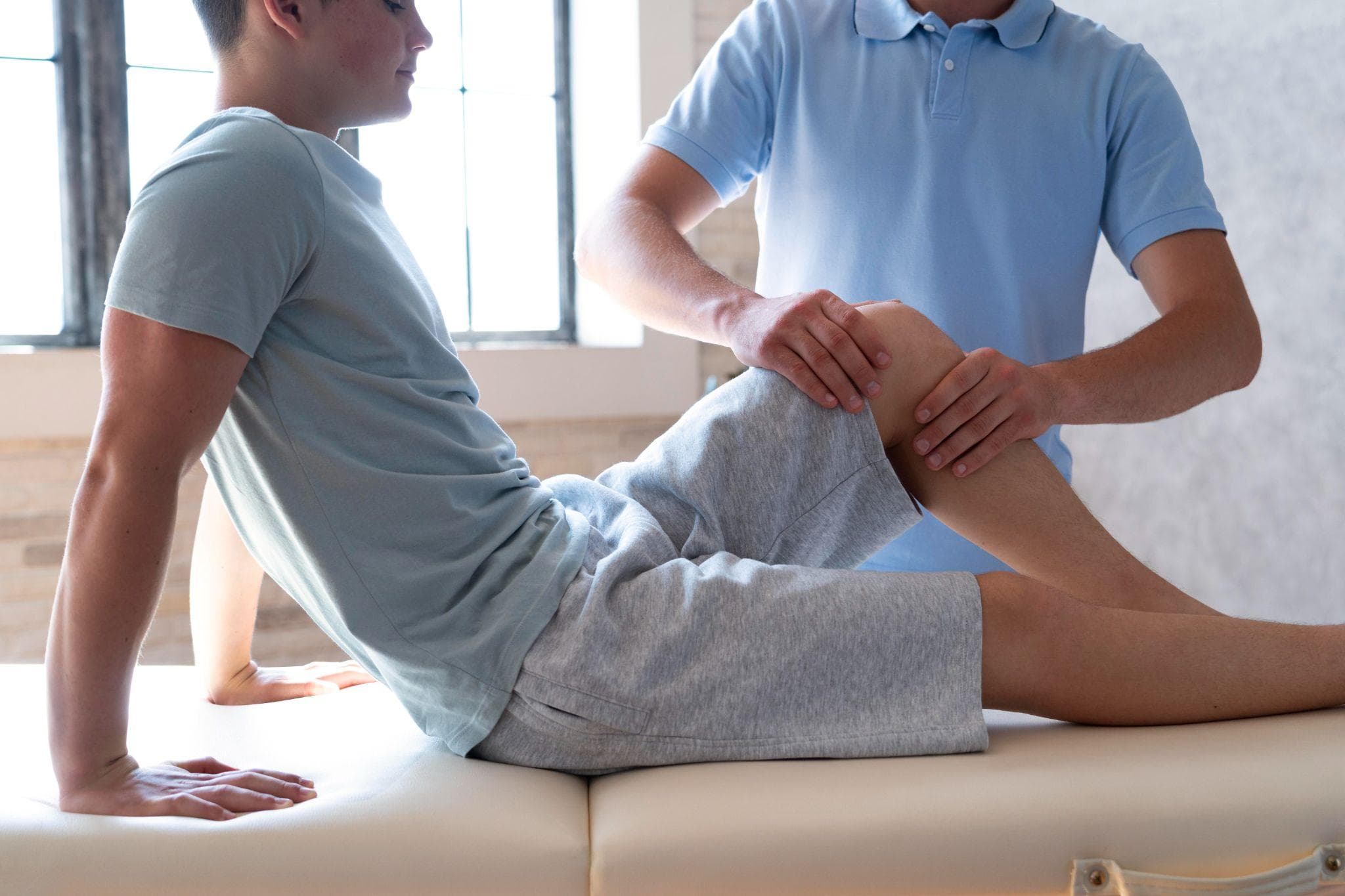
A physiotherapist helping a patient recover knee movement after surgery.
Doing too much too soon: Patients who push beyond their protocol often develop significant swelling and set themselves back by weeks. Respect the staging.
Missing physiotherapy: Exercises are not optional extras — they are the mechanism of recovery. Missed sessions directly impact the timeline.
Poor nutrition: Protein, calcium, and vitamin D support healing. Collagen synthesis (essential for ligament and cartilage repair) requires adequate nutritional input.
Smoking: Nicotine significantly impairs tissue healing and should be stopped before surgery and throughout recovery.
Pre-existing health conditions: Diabetes, obesity, and cardiovascular disease all influence recovery speed.
Frequently Asked Questions
Q: When can I walk normally after knee arthroscopy?
After simple procedures (meniscectomy): 1–3 weeks. After ACL reconstruction: 4–6 weeks (walking without aids). A fully normal, unassisted gait without a limp: 3–4 months.
Q: How long do I need crutches after knee arthroscopy?
For meniscectomy: typically 3–7 days. For meniscal repair: 4–6 weeks. For ACL reconstruction: 2–4 weeks.
Q: When can I drive after knee arthroscopy?
For simple procedures involving the right leg: 1–3 weeks. For the left leg with an automatic gearbox: often sooner. For ACL reconstruction: 4–6 weeks minimum.
Q: Is it normal for the knee to still swell months after arthroscopy?
Swelling with activity can persist for 3–6 months, particularly after meniscectomy and ACL surgery. It is the joint's response to increased load. It decreases progressively with rehabilitation.
Q: Where can I have knee arthroscopy and rehabilitation in Greater Noida?
Dr. Akash Dubey performs arthroscopic surgery at KDSG Superspeciality Hospital, Greater Noida. His clinic at Gaur City 2, Greater Noida West provides pre- and post-operative care and rehabilitation planning.
Contact Dr. Akash Dubey — Your Bone Mechanic
Dr. Akash Dubey
MBBS (KGMU, Lucknow) | MS | DNB Ortho | FIAS | FIJR | FIFA Diploma in Football Medicine
Robotic Surgery Certified | Member, AOPAS
Clinic: Shop No. 24, Ground Floor, Gaur City Arcade, Near Sarvodaya Hospital, Gaur City 2, Greater Noida West, U.P. – 201301
To book a consultation, call +91-8130441429