Is Arthroscopy Effective for Arthritis? What Current Evidence Actually Says
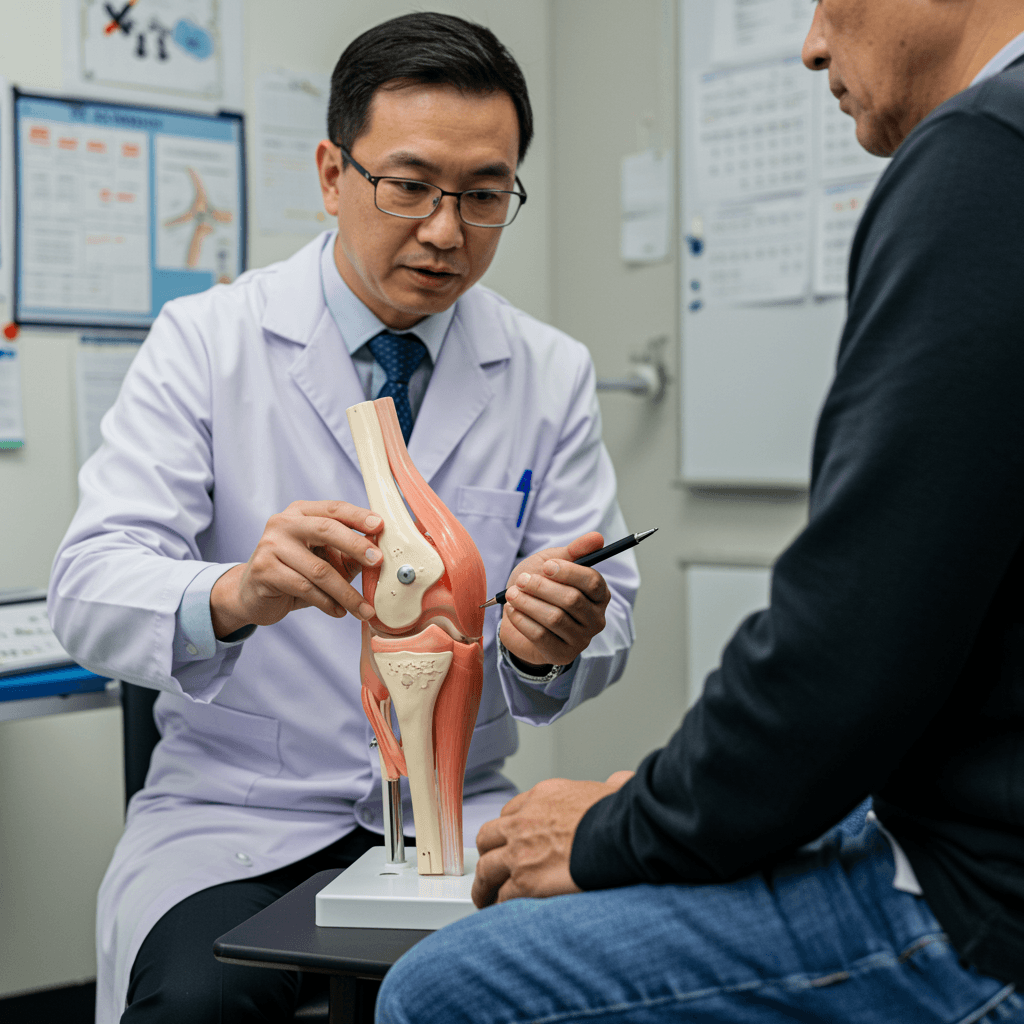
An orthopedic doctor explaining knee joint anatomy to a patient during consultation.
Patients with knee arthritis are sometimes offered arthroscopy — keyhole surgery to "clean out" the joint, remove loose fragments, or smooth damaged cartilage. The appeal is understandable: it is minimally invasive, relatively quick, and the recovery seems far easier than a knee replacement. If it can buy years of relief, it sounds like a reasonable option.
The research, however, does not support this enthusiasm. Multiple large, well-designed clinical trials — the kind that define clinical practice — have shown that arthroscopy for knee osteoarthritis produces no meaningful advantage over conservative treatment. Understanding why this is the case, and when arthroscopy in the context of arthritis is legitimately indicated, is what this article is about.
This is not a straightforward "never do it" or "always do it" story. The evidence is nuanced. And the nuance matters.
What Research Has Found
The landmark study is the Moseley trial (2002), published in the New England Journal of Medicine. It randomly assigned patients with knee osteoarthritis to receive arthroscopy with lavage, arthroscopy with debridement, or sham surgery. All three groups improved — including the sham surgery group. The conclusion: arthroscopy added no meaningful benefit beyond placebo for knee osteoarthritis.
The Kirkley trial (2008), also in the NEJM, compared arthroscopy plus optimised physiotherapy to physiotherapy alone in knee OA patients. Again, no significant difference in pain or function at 2 years.
The FIDELITY trial (2013), looking specifically at partial meniscectomy for degenerative meniscal tears in middle-aged patients with coexisting osteoarthritis, showed that sham surgery (skin incisions without any actual arthroscopic intervention) produced equivalent results to actual partial meniscectomy at 12 months and beyond.
A 2024 systematic review published in BMC Musculoskeletal Disorders, analysing multiple RCTs, concluded: "The evidence does not support the effectiveness of arthroscopic knee surgery compared to conservative treatments in knee OA."
These findings are consistent. For isolated knee osteoarthritis, arthroscopy is not superior to well-managed conservative care.
Why Arthroscopy Cannot Fix Arthritis
Understanding the biology explains why this makes sense.
1. Arthritis is a disease of cartilage loss.
In osteoarthritis, the cartilage that cushions the joint surfaces progressively degrades. Once cartilage is gone, it does not regenerate. There is no articular cartilage in the human knee that can grow back without a specific biological intervention (microfracture, cartilage transplant) — and even those interventions produce fibrocartilage, not the original hyaline cartilage.
2. Lavage does not change the disease.
Washing out the joint removes debris — inflammatory mediators, loose particles — but the source of these products (the degrading cartilage) remains. Symptoms may temporarily improve because the inflammatory environment has been diluted. But the underlying process continues.
3. Debridement removes tissue that is already degenerating.
Smoothing irregular cartilage surfaces sounds logical. But the benefit is short-lived because the remaining cartilage continues to degrade by the same disease process.
4. Pain in osteoarthritis is not primarily mechanical.
A common assumption is that arthritic pain is caused by rough surfaces and loose bits rubbing together. But much of the pain in OA comes from subchondral bone stress, synovial inflammation, and sensitisation of pain pathways — none of which arthroscopy addresses.
When Arthroscopy in the Context of Arthritis IS Appropriate
This is the important nuance. Saying "arthroscopy for arthritis does not work" does not mean "arthroscopy in any arthritic knee is never appropriate."
There are specific scenarios where arthroscopy is genuinely indicated even in patients who have some degree of osteoarthritis:
Mechanical Symptoms from a Specific Structural Problem
The distinction is between:
- Pain from arthritis (the diffuse, aching, activity-related pain of OA) → arthroscopy does not help
- Mechanical symptoms from a specific structure (locking from a displaced bucket-handle tear, sharp catching from a loose body) → arthroscopy can help
A patient with knee OA who develops a bucket-handle tear that is causing the knee to lock has a mechanical problem superimposed on their arthritis. Removing the locked meniscus fragment resolves the locking — even if the underlying OA continues. This is a legitimate indication.
Similarly, a patient with mild arthritis who has a loose body causing sharp intermittent catching and swelling — removing the loose body makes sense, even though it does not address the arthritis.
The key clinical question: Are the symptoms mechanical (locking, catching, sudden pain with specific movement) or diffuse (aching throughout activity, morning stiffness, swelling that builds over the course of a day)?
Mechanical symptoms from a confirmed structural cause → arthroscopy may be appropriate.
Diffuse arthritic pain without a specific structural target → arthroscopy is not appropriate.
Concurrent Pathology in a Relatively Early OA Knee
A patient with early or moderate OA and a confirmed meniscal tear — particularly an acute traumatic tear — may benefit from arthroscopy. The evidence against surgery applies most clearly to degenerative tears in middle-aged patients with moderate-to-advanced OA. For a younger patient with early OA and an acute traumatic tear, the picture is different.
The Honest Clinical Conversation
At Dr. Akash Dubey's clinic in Gaur City 2, Greater Noida West, patients with arthritic knee pain and a request for arthroscopy receive an honest evaluation:
1. If the primary symptoms are diffuse arthritic pain:
Arthroscopy is not recommended as a primary treatment. The evidence does not support it, and it exposes the patient to surgical risk without meaningful benefit. The discussion moves to optimised non-surgical management — weight loss, strengthening, anti-inflammatory strategies, intra-articular injections, and eventually joint replacement if the disease progresses.
2. If there is a specific mechanical problem superimposed on arthritis:
The clinical and imaging findings are examined carefully. If a locked knee, a confirmed bucket-handle tear, or a loose body is identified as the cause of new or worsening symptoms, surgery may be appropriate — with clear communication that it addresses the mechanical problem, not the underlying arthritis.

Elderly man grimacing in pain while holding his inflamed knee
3. This is the clinical nuance that separates appropriate use from overuse:
A significant portion of arthroscopy performed for "knee pain" in middle-aged patients in India — as globally — is performed without a specific mechanical target, for diffuse arthritic pain. The evidence does not support this.
Alternatives to Arthroscopy for Arthritic Knee Pain
For patients with knee OA who are not appropriate for arthroscopy:
Physiotherapy and strength training — Quadriceps strengthening is the most reliably effective non-surgical intervention for knee OA pain and function. It reduces pain and improves function at 12 months and beyond.
Intra-articular injections — Cortisone for acute inflammatory flares; hyaluronic acid (viscosupplementation) for certain OA patterns; PRP for select cases. See Dr. Dubey's intra-articular injection guidance for more detail.
Weight management — For every kilogram of body weight lost, approximately 4–5 kg of load is reduced from the knee joint with each step. This has a measurable impact on pain and progression.
Osteotomy — In patients with significant deformity (bow-legs causing medial compartment overload), a high tibial osteotomy (realigning the tibia to shift load away from the damaged compartment) can buy years before replacement is needed.
Joint replacement — For advanced OA where conservative management no longer provides adequate relief.
Frequently Asked Questions
Q1: My doctor suggested arthroscopy for my arthritic knee. Should I get a second opinion?
It is reasonable to ask what specific mechanical problem the surgery is targeting. If the answer is "to clean out the joint" without a specific structural cause for mechanical symptoms, asking for a second opinion is appropriate.
Q2: Is there any type of arthroscopy that helps with arthritis?
Microfracture (stimulating fibrocartilage growth) has a role for specific focal cartilage defects in younger patients without widespread OA. Osteochondral grafting and cartilage transplant techniques address focal cartilage loss. These are different from "cleaning out" an arthritic joint.
Q3: If arthroscopy does not fix arthritis, what does?
No available treatment reverses established OA. Effective management slows progression, reduces pain, and maintains function — through physiotherapy, injections, weight management, and eventually joint replacement when necessary.
Q4: Is arthroscopy available in Greater Noida for appropriate indications?
Yes. Dr. Akash Dubey performs arthroscopic procedures at KDSG Superspeciality Hospital, Greater Noida, for patients with confirmed mechanical joint pathology.
Contact Dr. Akash Dubey — Your Bone Mechanic
Dr. Akash Dubey
MBBS (KGMU, Lucknow) | MS | DNB Ortho | FIAS | FIJR | FIFA Diploma in Football Medicine
Robotic Surgery Certified | Member, AOPAS
Clinic: Shop No. 24, Ground Floor, Gaur City Arcade, Near Sarvodaya Hospital, Gaur City 2, Greater Noida West, U.P. – 201301
To book a consultation, call +91-8130441429