Life After Knee Replacement: A Complete 6-Month Recovery Roadmap
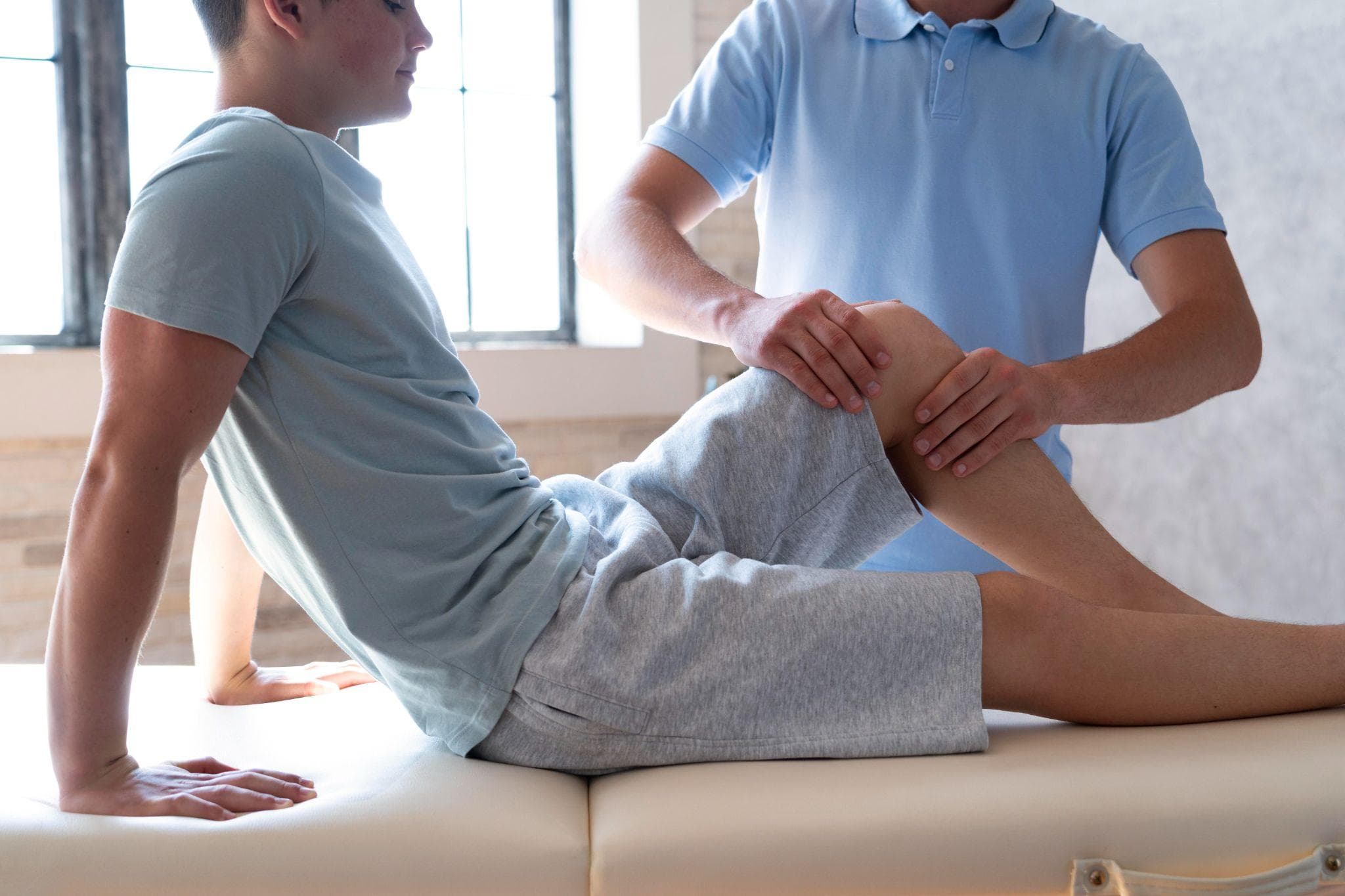
A physiotherapist helping a patient recover knee movement after bone injury treatment.
The surgery is one day. Recovery is six months.
That sentence, simple as it is, surprises a lot of patients. They expect a dramatic moment of surgery and then a fairly rapid return to normal life. The reality is more gradual — and in some ways more demanding — than many anticipate.
The good news is that recovery from knee replacement is largely predictable. Knowing what is coming — what is normal, what is progress, what is a red flag — makes the process far less anxious. This guide gives you the honest roadmap, stage by stage.
Dr. Akash Dubey, MBBS (KGMU, Lucknow), MS, DNB Ortho, FIAS, FIJR, Robotic Surgery Certified, performs knee replacement surgery at KDSG Superspeciality Hospital, Greater Noida. The recovery framework here reflects both clinical evidence and what his patients experience in practice.
Before Surgery: Prehabilitation Matters
Recovery does not begin the day after surgery. It begins in the weeks before it.
Prehabilitation — targeted exercises before surgery to strengthen the muscles around the knee — has clear evidence behind it. Patients who enter surgery with stronger quadriceps, hip muscles, and better cardiovascular fitness consistently recover faster. Even 2–4 weeks of focused exercises makes a measurable difference.
Pre-operative exercises to ask your physiotherapist about:
- Straight leg raises
- Quad sets (tightening the thigh muscle with leg straight)
- Terminal knee extensions
- Short-arc quads
- Hip abductor strengthening
Weight management is also worth working on before surgery. Every kilogram of body weight reduction takes several kilograms of load off the knee implant — both during surgery and throughout the life of the implant.
Day of Surgery and Immediate Post-Op (Days 0–2)
Most patients are walking the same day as surgery. This is not an exaggeration — physiotherapy starts within hours of the procedure, once the anaesthesia has worn off enough for the team to safely get you standing.
The first steps with a walker feel strange. The knee may feel tight, slightly swollen, and very different from what you expect. That is normal. The goal of the first 24 hours is not to walk far — it is to move enough to start blood circulating in the legs and to demonstrate that the knee can bear weight.
Pain is managed with a combination of oral medications, ice packs, and in many cases, a nerve block given during surgery that numbs the knee for the first 12–24 hours.
Range of motion target by end of Day 2: 70–80 degrees of knee bend.
Week 1: The Hardest Week
You will likely be discharged home on day 2 or 3, unless there are specific medical reasons to stay longer. The first week at home is, for most patients, the most challenging of the entire recovery.
1. What to Expect
- Significant swelling and bruising — the entire knee and often the lower leg will look dramatically swollen. This is from surgical trauma and is completely expected.
- Pain that is real but manageable — take medications as prescribed, on a schedule, rather than waiting until the pain peaks.
- Fatigue — major surgery tires the entire body. The anaesthesia, the blood loss, the inflammation — all of this takes energy to process. Rest is not laziness; it is recovery.
- Night pain — sleep disruption in the first week is very common. Pain and the need to keep the leg elevated interfere with sleep. Most patients find this improves by week 3–4.
2. What You Should Be Doing
Exercises (3–4 times per day):
- Ankle pumps — moving the foot up and down to keep blood circulating
- Quad sets — tightening the thigh muscle without bending the knee
- Heel slides — sliding the heel toward the buttocks to bend the knee gently
- Straight leg raises — lifting the leg straight to build quadriceps strength
Walking: Short distances with your walker, 3–4 times per day. The goal is frequency, not distance. Around the room, to the bathroom, to the kitchen — these count.
Ice and elevation: 20 minutes of ice every 2 hours. Elevate the leg with the ankle supported (not a pillow behind the knee — this encourages a bent position and can limit straightening).
Week 2–6: Building the Foundation
By the end of week 2, many patients feel a turning point. Pain is still present but less sharp. The swelling, while still significant, starts to plateau. Walking distance is increasing.
1. Range of Motion Goals
- 90 degrees of knee bend by week 2 (most patients achieve this)
- 110 degrees by week 6 (standard physiotherapy milestone)
These targets matter. The range-of-motion window — the period where the joint is still responding well to stretching — is most open in the first 3 months. Gains made here tend to stay. Gains missed here are harder to recover later.
2. Walking Progression
- Week 2–3: Progress from walker to crutches (if you have the strength and balance)
- Week 3–4: Short walks outdoors begin
- Week 4–6: Cane replaces crutches; distance increases
Driving: Most patients are cleared to drive at 4–6 weeks, once they can quickly and firmly apply the brake pedal. If the right leg was operated on, this is the limiting factor. For left-leg surgery with an automatic gearbox, driving may be possible slightly earlier.
3. Work Return
- Desk work: typically 4–6 weeks
- Moderate physical work: 3 months minimum
- Heavy physical labour: 4–6 months, surgeon clearance required
Month 2–3: Gaining Momentum
This is where recovery starts to feel like progress rather than just managing pain.
Swelling has reduced significantly, though some swelling with activity can persist for up to 6 months — this is normal. Stiffness at the end of the day is common.
What Changes
- Walking is more confident, less effortful
- Stairs are manageable with a railing (step up with the good leg, step down with the operated leg — "up with the good, down with the bad")
- Physiotherapy shifts from range-of-motion focus to strength training
- Hip and core exercises are added
- Stationary cycling begins — excellent for range of motion and cardiovascular fitness without impact
Range of motion target by month 3: 120+ degrees. At this point, the range you have is close to what you will keep long-term — the window is still open but beginning to close.
Month 3–6: Returning to Life
By month 3, most patients are walking without aids, managing daily activities, and back to their routine. The knee still feels different — some tightness, occasional swelling after long walks, slight stiffness in the morning — but function is vastly better than before surgery.
What to Focus On
Strength: The quadriceps and gluteal muscles need to be rebuilt properly. Weak quads mean more load through the implant, less stability, and a slightly limping gait.
Gait normalisation: Some patients develop a slight limp during the non-weight-bearing or partial-weight-bearing phase that persists into recovery. Specific gait training addresses this — consciously working on even stride length, full knee extension during walking, and avoiding the tendency to hitch the hip.
Functional activities: Return to activities of meaning — walking in the park, playing with grandchildren, gardening, cooking longer meals. These are the objectives that motivated the surgery. Working toward them deliberately, with appropriate pacing, is part of rehabilitation.
Low-impact exercise:
- Walking (progressively longer distances)
- Swimming and pool walking
- Cycling (stationary then road)
- Golf (typically from month 4–6 with surgeon clearance)
Month 6 and Beyond
Full functional recovery from knee replacement can take up to 12–18 months. This is not because something is wrong — it is because the muscles continue to strengthen, the nervous system continues to adapt to the new joint, and the subtle proprioception (sense of joint position) gradually improves.
Most patients report that the knee "feels normal" somewhere between 6 and 12 months. Some notice continued improvement at 18 months.
Long-Term Considerations
Avoid high-impact activities — running, contact sports, heavy lifting — to protect the implant from premature wear.
Maintain your weight — every kilogram off the scale is several kilograms of reduced load on the joint.
Keep your follow-up appointments — the implant should be reviewed periodically with X-rays. Catching any early wear or loosening before it becomes a problem is the purpose of long-term follow-up.
Stay active — a sedentary life after knee replacement is not protective; it weakens the muscles that support the joint and accelerates overall health decline. The goal is appropriate activity, not inactivity.
Common Concerns During Recovery
"My knee makes a clicking noise." Some clicking and popping is normal after knee replacement. The joint is new, the soft tissues are adapting, and slight movement of the components during flexion can produce sound. Unless it is accompanied by pain, swelling, or instability, it is not a concern.
"I have more pain on some days than others." Recovery is not linear. Overexertion one day results in more pain and swelling the next. The overall trend should be improvement over weeks — individual days will vary.
"My knee still swells when I overdo it." Normal for up to 6 months, and sometimes beyond. Reduce activity, ice, and elevate. Resume gradually.
"The scar is still sensitive." Scar sensitivity and occasional numbness around the incision are common for months after surgery. Scar massage after the wound has fully healed helps desensitise the area.
Frequently Asked Questions
Q: How soon after knee replacement surgery can I walk normally?
Most patients walk without aids at 4–6 weeks. A normal, unassisted gait without a limp typically develops over 3–6 months with consistent physiotherapy.
Q: Can I kneel after knee replacement?
Kneeling is possible for many patients after complete recovery, but can feel uncomfortable due to the implant's different sensation at the front of the knee. Some patients kneel comfortably; others find it uncomfortable. It is not harmful to the implant.
Q: When can I climb stairs normally after knee replacement?
One step at a time with a railing from week 2–3. Alternating feet on stairs (normal stair climbing) typically returns by month 2–3.
Q: Is it normal to feel emotional during recovery?
Very. Recovery from major surgery is physically and psychologically demanding. Fluctuating mood, frustration with slow progress, and anxiety about the outcome are all common. These improve as function improves.
Q: Where can I get structured knee replacement rehabilitation in Greater Noida?
Dr. Akash Dubey at Your Bone Mechanic clinic, Gaur City 2, Greater Noida West provides post-operative care and rehabilitation planning as part of every joint replacement programme.
Contact Dr. Akash Dubey — Your Bone Mechanic
Dr. Akash Dubey
MBBS (KGMU, Lucknow) | MS | DNB Ortho | FIAS | FIJR | FIFA Diploma in Football Medicine
Robotic Surgery Certified | Member, AOPAS
Clinic: Shop No. 24, Ground Floor, Gaur City Arcade, Near Sarvodaya Hospital, Gaur City 2, Greater Noida West, U.P. – 201301
To book a consultation, call +91-8130441429