Life After Pelvic Reconstruction Surgery: Real Recovery Tips from an Orthopedic Expert
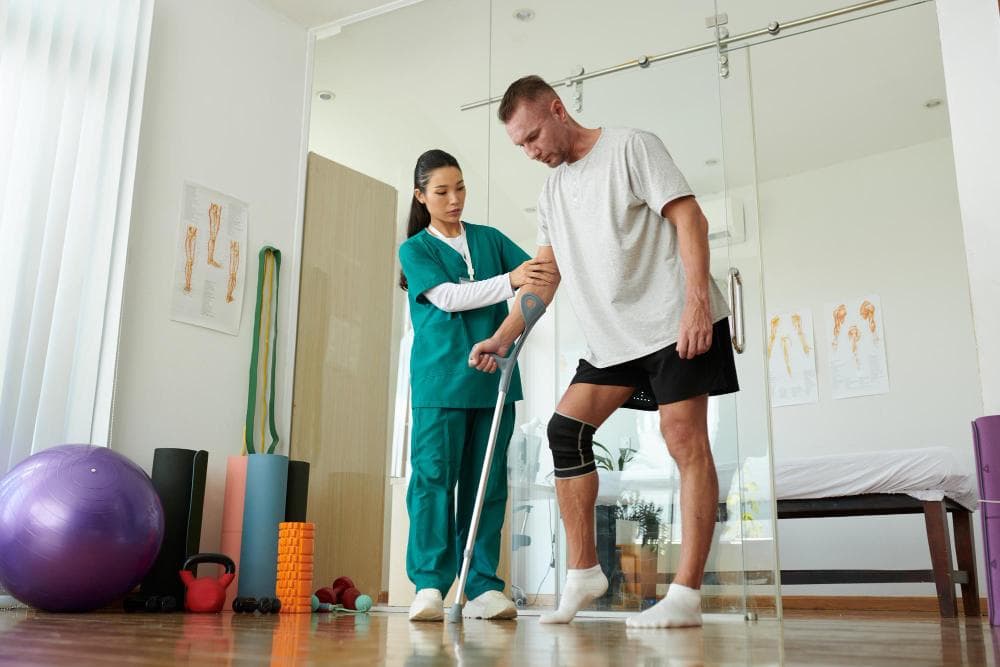
A nurse is helping a patient with a knee brace and a clutch with walking in a physiotherapy room.
Nobody comes through pelvic reconstruction surgery and walks out the next day feeling normal. That is just not how it works. The surgery is complex, the anatomy involved is dense, and the pelvis is the kind of structure that needs time — real time — before it behaves the way it used to.
But here is what is also true: the majority of patients who go through pelvic reconstruction do get their lives back. Some more completely than others, depending on the severity of the fracture and how it was managed. The recovery is long, sometimes frustrating, and occasionally non-linear. But it is possible.
This article is for patients who have had — or are preparing for — pelvic reconstruction surgery, and for the families who are going through it alongside them. It covers the practical realities of recovery: what changes, what to expect at each stage, what helps, and what does not.
Dr. Akash Dubey, MBBS (KGMU, Lucknow), MS, DNB Ortho, Certified Pelvic-Acetabular Surgeon and Member of AOPAS, has guided many patients through this recovery in Greater Noida and the NCR. The insights here are grounded in the clinical reality of these cases.
What "Pelvic Reconstruction" Actually Means
The term pelvic reconstruction surgery covers a range of procedures. What they have in common is that they restore the structural integrity of the pelvic ring or acetabulum (hip socket) after it has been disrupted — either by a major traumatic fracture, a tumour, or developmental conditions.
In the context of trauma surgery, pelvic reconstruction typically refers to:
- Open Reduction and Internal Fixation (ORIF) of the pelvic ring — plates and screws applied to restore alignment of the anterior and/or posterior pelvic ring
- Acetabular ORIF — surgical reduction and fixation of the hip socket
- Combined anterior and posterior fixation — for complex, unstable fractures involving both the front and back of the pelvis
- Secondary reconstruction — corrective surgery for fractures that healed in a poor position (malunion) or failed to heal (non-union)
What the surgery does is restore anatomy. What recovery does is restore function. And those are two very different things.
The First Week Home: Managing the Basics
The first week after hospital discharge is often the hardest. You are in pain, tired, dependent on others, and probably sleeping badly. The anaesthesia and surgical stress leave most patients feeling worse than they expected.
Pain management — You will have prescription pain medication. Take it on schedule, not just when the pain becomes unbearable. Staying ahead of the pain is easier than chasing it. As the weeks pass, the dose is gradually reduced.
Wound care — Keep the incision site clean and dry. No soaking in water. If you notice increased redness, warmth, swelling, or any discharge from the wound, call your surgeon's office.
Blood clot prevention — You will likely be on blood thinners (anticoagulants) for several weeks. Take them exactly as prescribed. Walk (with your aids) for short periods multiple times a day — even just around the room — to keep blood moving in your legs.
Sleep position — Most patients find sleeping on their back with a pillow under the knees most comfortable. Avoid lying on the operated side until your surgeon clears it.
Transfers — Getting in and out of bed, sitting on the toilet, and getting into a car all require technique when the pelvis is healing. Your physiotherapist will have taught you how to do these before discharge. Use those techniques every time — without shortcuts.
The Non-Weight-Bearing Phase: Patience Is the Work
For most pelvic reconstruction patients, the first 6–10 weeks involves strict non-weight-bearing on the affected side. This means the foot can touch the ground — for balance — but no real body weight goes through that leg or through the pelvis.
This phase tests patience more than physical endurance. You feel relatively okay. Your pain is improving. You want to just put weight on it and walk — and your physio keeps telling you not to. They are right.
The fixation hardware holds the bones in position, but the bone itself needs 6–8 weeks to begin forming solid union at the fracture site. Loading before that happens risks displacing the fragments or breaking the hardware — setting you back significantly.
Making Non-Weight-Bearing Liveable
- Crutches vs. walker — Walkers give more stability and are often better for the first few weeks. Crutches allow more independence. Your physio will recommend based on your strength and balance.
- Raised toilet seat — A toilet seat raiser makes a significant difference to independence and dignity during this phase.
- Bedside commode — If getting to the bathroom is very difficult, a bedside commode for nighttime use can prevent dangerous trips.
- Shower stool — A seated shower removes the risk of losing balance on one leg.
- Remove rugs and clutter — Every trip hazard in the home is a real danger during this phase. Do a walk-through with a family member and eliminate as many as possible.
Physiotherapy: The Most Important Part of Recovery
If there is one non-negotiable in pelvic reconstruction recovery, it is physiotherapy. Not just attending the sessions, but doing the home exercises consistently between visits.
What Physio Looks Like at Each Stage
Weeks 1–6 (non-weight-bearing):
- Ankle pumps and circles
- Isometric glute and quad sets (tensing the muscles without moving the joint)
- Upper body and core strengthening
- Breathing exercises
- Gentle hip range-of-motion (guided by physio, not self-directed)
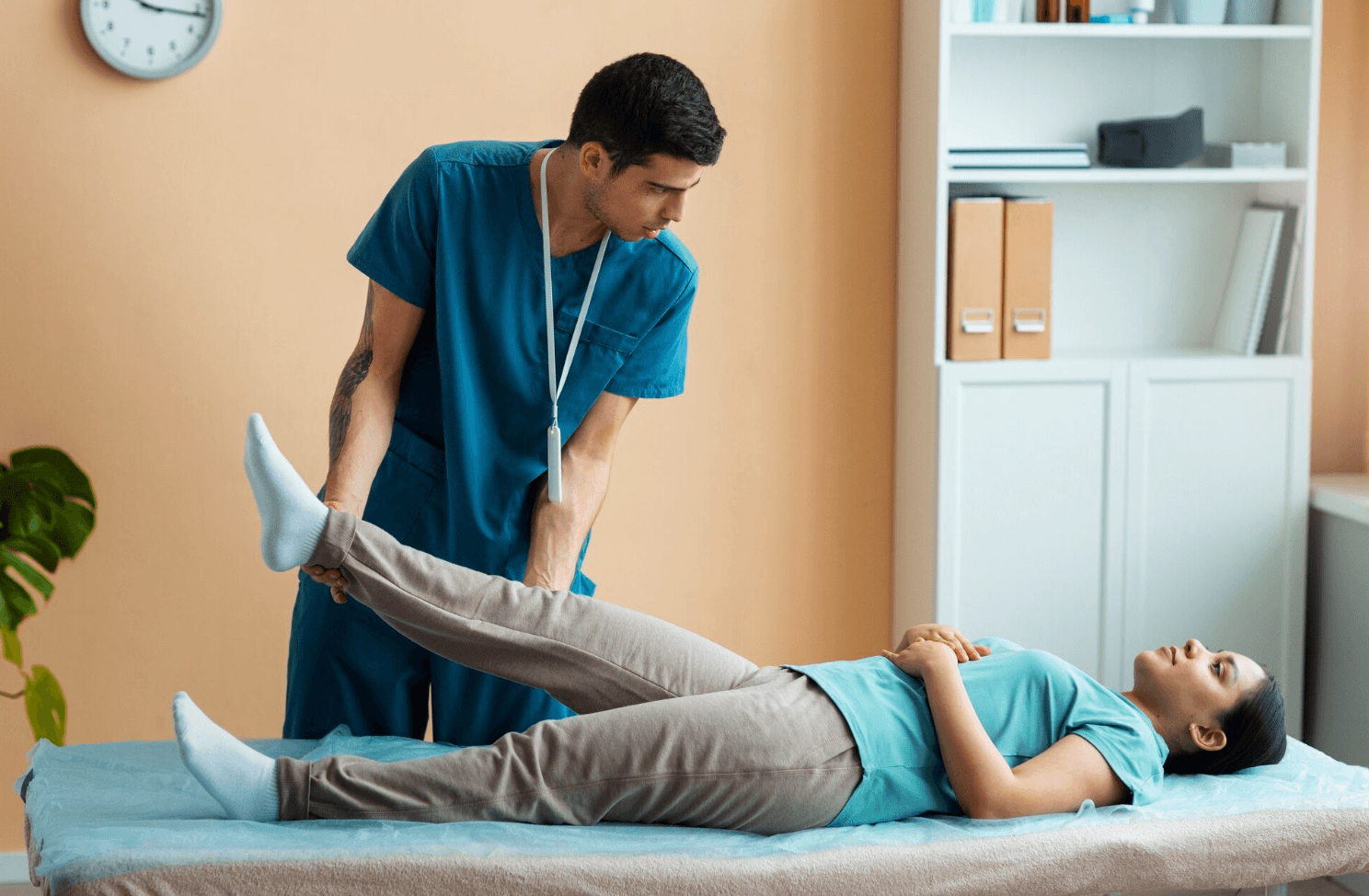
A physiotherapist is helping a patient with her knee.
Weeks 6–12 (partial to full weight-bearing):
- Progressive weight-bearing with walker, then crutches, then unassisted
- Hip abductor strengthening (side-lying leg raises)
- Stationary cycling — low resistance initially
- Aquatherapy (pool walking) — excellent during this phase as water reduces joint load
- Balance training
Month 3–6:
- Full gait training — addressing the limp, normalising stride length
- Functional exercises: stair climbing, sit-to-stand, getting in and out of the car
- Progressive resistance exercises for hip, glute, and core
- Return-to-activity planning
Month 6 and beyond (where needed):
- Sport-specific rehabilitation for active patients
- Advanced strength and conditioning
- Monitoring for any late-developing pain or complications
What Gets Better — and What Might Not
1. What typically improves
- Pain at the fracture site — improves steadily over 3–6 months
- Walking ability — most patients achieve independent walking by 3–4 months
- Sitting tolerance — improves as the pelvis heals
- Sleep quality — disrupted early on, usually normalises by 2–3 months
- Functional independence — most daily activities return by 4–6 months
2. What may persist or take longer
Fatigue — Recovering from major trauma and surgery is exhausting. Fatigue often lasts longer than patients expect — sometimes well beyond 6 months in complex cases.
Mild limp — Some patients retain a subtle limp even after full recovery. This is more common in fractures that involved the acetabulum or in cases where anatomical reduction was imperfect.
Nerve-related symptoms — If the sciatic nerve or lumbosacral plexus was injured in the original fracture, numbness, tingling, or weakness in the leg can persist for months — and in some cases, permanently. Nerve recovery, when it happens, is slow — nerves heal roughly 1mm per day.
Scar sensitivity — The surgical incisions may remain tender for several months. Scar massage (after the wound has fully healed) can help desensitise the area.
Post-traumatic arthritis — In acetabular fractures, even a well-repaired fracture can develop arthritis in the hip joint over years. Regular follow-up allows this to be monitored and managed.
The Emotional Reality of Pelvic Reconstruction Recovery
This is the part that does not get talked about enough.
Major pelvic surgery changes a person's life, at least temporarily. You lose independence. You may not be able to work. If the injury was from a road accident, you may have significant anxiety about vehicles, or flashbacks to the accident. The disruption to normal life — family roles, financial stress, identity — is real and significant.
Mood changes are common. Irritability, low motivation, and mild depression affect many patients in the weeks following major orthopaedic surgery. These are not weakness — they are understandable responses to pain, disruption, and enforced dependence.
Talking helps. Whether with family, a counsellor, or even a support group, putting words to the frustration and anxiety of recovery is genuinely useful. Some patients find it helpful to connect with others who have been through similar surgeries.
Be honest with your surgeon about how you are coping — not just physically, but emotionally. Recovery decisions (when to start weight-bearing, when to return to work) are better made when the doctor knows the full picture.
Returning to Work and Daily Life in Greater Noida
The timeline for returning to work depends entirely on what you do:
- Desk-based / sedentary work — Some patients return to light desk work at 6–8 weeks, often initially from home
- Moderate physical work — 4–6 months minimum
- Heavy manual labour or field work — 6–12 months, and only after formal clearance from the surgeon
Driving — Generally cleared between 6–12 weeks, once the surgeon confirms that the reaction speed and physical capacity to operate a vehicle safely are restored. Never drive while on narcotic pain medication.
Social activities — Short outings, family gatherings, and managed social activities can begin as soon as you feel physically able. Do not wait for "complete recovery" to engage with the world again.
Frequently Asked Questions
Q1: Will I walk normally again after pelvic reconstruction?
Most patients do. The timeline varies — some are walking without aids at 3 months, others take closer to 6. Full, normal gait is achievable for the majority of patients with complex pelvic fractures if rehabilitation is properly done.
Q2: Can I have sex after pelvic reconstruction surgery?
This is a question many patients have but do not ask. Sexual activity is generally resumed after the pelvis has healed and the surgeon has cleared full weight-bearing — typically from 3–4 months onward. Comfort and positioning may need adjustment initially.
Q3: Is it normal to have more pain some days than others during recovery?
Yes. Recovery is not linear. Days of increased activity are often followed by a day of more pain. This is expected. The overall trend should be improvement over weeks and months, even if individual days vary.
Q4: Will I need another surgery?
Most patients do not need a second procedure. Hardware removal is sometimes done 6–12 months after surgery if screws cause discomfort, particularly in the posterior pelvis. In cases of post-traumatic arthritis, a hip replacement may be required years later.
Q5: Where can I get pelvic reconstruction surgery and follow-up care in Greater Noida?
Dr. Akash Dubey at Your Bone Mechanic clinic, Gaur City 2, Greater Noida West provides complete pelvic fracture care — from initial assessment through surgery, rehabilitation planning, and long-term follow-up.
Contact Dr. Akash Dubey — Your Bone Mechanic
Dr. Akash Dubey
MBBS (KGMU, Lucknow) | MS | DNB Ortho | FIAS | FIJR | FIFA Diploma in Football Medicine
Certified Pelvic-Acetabular Surgeon | Member, AOPAS
Clinic: Shop No. 24, Ground Floor, Gaur City Arcade, Near Sarvodaya Hospital, Gaur City 2, Greater Noida West, U.P. – 201301
To book a consultation, call +91-8130441429