Meniscus Tear Treatment in Noida: Surgical vs. Non-Surgical Options Explained
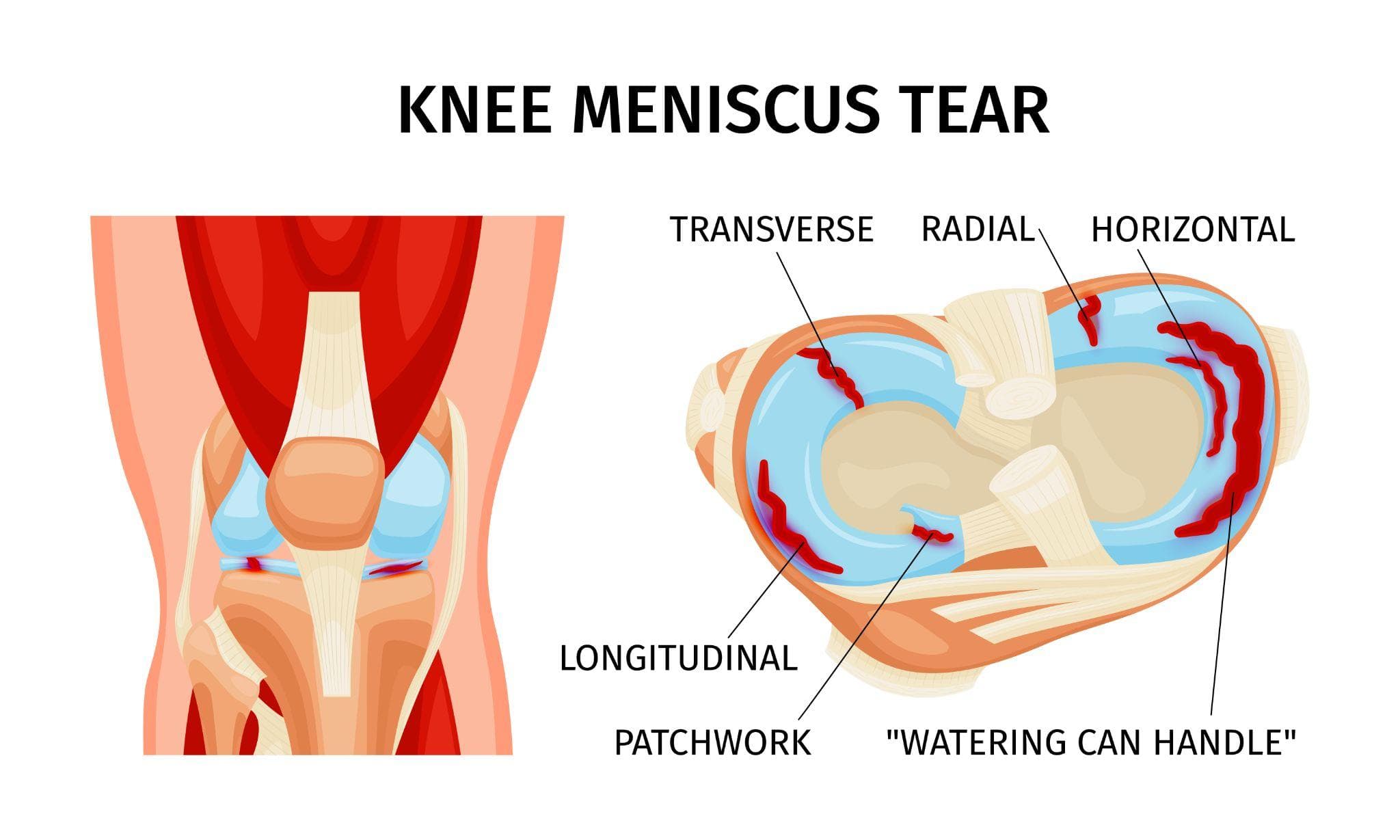
An anatomical illustration of a knee joint with labels for different types of meniscus tears. On the left, a front view shows the femur and tibia, while the right side provides a detailed cross-section of the knee.
The meniscus gets discussed frequently and understood poorly. Patients come in with an MRI report saying "meniscal tear" and immediately assume they need surgery. Their neighbour had a meniscal tear and needed surgery. Their physiotherapist is warning them against heavy exercise. Someone online told them to try injections first.
The reality is that meniscal tears are a spectrum. Some need surgery relatively promptly. Some respond very well to conservative management and never require a procedure. And some — particularly in middle-aged or elderly patients — are incidental findings on MRI that are not actually causing the pain the person is experiencing.
Getting this right matters. Operating when it is not necessary exposes a patient to surgical risks without benefit. Avoiding surgery when it is genuinely necessary means months of unnecessary pain, recurrent episodes of locking or giving way, and potentially accelerated cartilage damage.
This article explains what determines which path is appropriate.
What the Meniscus Is and What It Does
Each knee has two menisci — C-shaped pads of fibrocartilage sitting between the femur (thigh bone) and tibia (shin bone). The medial meniscus is on the inner side, the lateral meniscus on the outer side.
Their functions are several: they distribute load across the knee, absorb shock during impact activities, and contribute to joint stability. When they are damaged, the knee loses these protective functions, and the articular cartilage beneath takes more direct load — which accelerates wear over time.
The meniscus has limited blood supply. Only the outer 25–30% (the "red zone") has enough blood supply to potentially heal. The inner 70–75% (the "white zone") does not. This has a critical implication: tears in the outer zone can sometimes heal with the right conditions; tears in the inner zone do not heal — they can only be managed by repair (in rare cases where anatomy permits) or by removal of the damaged fragment.
Types of Meniscal Tears
Understanding the type of tear is the first step in determining treatment.
Acute traumatic tears — occur from a specific injury: a twist, a pivot, a sudden change of direction. Common in athletes. Often accompanied by pain, swelling, and a clear history of an event. These tend to be more structurally significant.
Degenerative tears — occur over time from wear and accumulated stress. Common in middle-aged and older adults. Often without a clear injury event. May coexist with early osteoarthritis. Evidence strongly suggests these respond well to physiotherapy in many cases.
By morphology (shape):
- Horizontal tears — run parallel to the tibial surface. Often degenerative.
- Vertical/longitudinal tears — run along the length of the meniscus. Can be repairable if in the vascular zone.
- Radial tears — cut across the meniscus, disrupting its load-bearing ring function. Often need surgical management.
- Bucket-handle tears — a vertical tear that flips inward, causing the knee to lock. Nearly always require surgery.
- Flap tears — a flap of meniscus that catches and causes mechanical symptoms.
- Complex/degenerative tears — multi-plane, frayed tissue in the avascular zone. Common in older patients. Conservative management is often first-line.
Non-Surgical Treatment: When It Works and When It Does Not
For many meniscal tears — particularly degenerative ones in adults over 45 — a properly supervised conservative programme produces outcomes comparable to surgery at 12 months. Multiple large randomised trials, including the FIDELITY trial from Finland, showed that physiotherapy alone performed as well as arthroscopic partial meniscectomy for degenerative meniscal tears in middle-aged patients at 2 and 5 years.
This does not mean all meniscal tears should be treated non-surgically. It means degenerative tears in patients without mechanical symptoms deserve a proper conservative trial first.
Non-surgical treatment includes:
RICE in the acute phase — Rest, Ice, Compression, Elevation to reduce swelling and pain in the first 48–72 hours.
Activity modification — Avoiding movements that provoke symptoms (deep squatting, kneeling, twisting) while maintaining general fitness with low-impact activities.
Physiotherapy — The core of non-surgical management. Quadriceps and hamstring strengthening reduces load on the meniscus. Proprioception (balance) training addresses the joint's stability. Hip and glute strengthening reduces the rotational forces at the knee.
NSAIDs — Anti-inflammatory medications for acute pain episodes.
Intra-articular injections — Cortisone for acute inflammatory flares. PRP (platelet-rich plasma) has some evidence for degenerative meniscal tears, though it is not a structural repair.
Non-surgical management is appropriate for:
- Degenerative horizontal tears in patients over 45 without locking
- Small stable tears in the outer zone with minimal symptoms
- Patients with significant arthritic changes where surgery is unlikely to change outcomes
- Patients whose MRI shows a tear but whose symptoms are relatively mild and responsive to conservative measures
Surgical Treatment: When Surgery Is the Right Answer

Body showing signs of meniscus tear
Surgery for meniscal tears has two forms:
1. Partial Meniscectomy (Trimming)
The damaged portion of the meniscus is trimmed arthroscopically, removing only the unstable or flap-like tissue while preserving as much healthy meniscal tissue as possible. The remaining meniscus is smoothed and tidied.
Partial meniscectomy is indicated for:
- Mechanical symptoms (locking, catching) that have not resolved with conservative management
- Displaced bucket-handle tears
- Flap tears and complex tears causing recurrent pain and swelling with activity
- Tears in the avascular zone that cannot heal and are causing significant functional limitation after 6–8 weeks of physiotherapy
Important consideration: meniscectomy removes tissue that cannot grow back. Even partial removal of meniscal tissue increases the long-term risk of knee osteoarthritis in that compartment. This is a reason to preserve as much meniscus as possible — which is why trim-only (removing the minimum unstable tissue) is preferred to aggressive removal.
2. Meniscal Repair
For tears in the outer vascular zone — tears where the tissue has the blood supply to potentially heal — the surgeon places sutures through the torn edges under arthroscopic guidance, reapproximating the torn tissue so it can heal.
Meniscal repair is technically more demanding and has a longer recovery than meniscectomy, but the long-term benefit is substantial: the meniscus is preserved, load distribution is maintained, and the risk of progressive arthritis is reduced.
Repair is preferred for:
- Young patients with vascular zone tears
- Vertical/longitudinal tears in the outer third
- Acute tears without significant degeneration
- Bucket-handle tears (in some cases)
The trade-off: repair takes 3–6 months to heal. Patients are typically on crutches for 4–6 weeks and must avoid loading the repaired meniscus during that period. Meniscectomy has a much faster recovery (walking the same day, full activity in 4–8 weeks).
The Decision at Dr. Akash Dubey's Clinic in Greater Noida
When a patient presents with a meniscal tear at Your Bone Mechanic clinic in Gaur City 2, Greater Noida West, the evaluation includes:
- History: Was there an injury? What makes the symptoms worse? Is there locking?
- Examination: Meniscal provocation tests, range of motion, effusion assessment
- MRI review: Tear type, location, zone (vascular vs. avascular), presence of associated damage
The default for degenerative tears in middle-aged patients without mechanical symptoms: structured physiotherapy first. Six to eight weeks, properly supervised. If symptoms resolve, no surgery is needed. If symptoms persist — particularly if there is locking, recurrent effusion, or significant functional limitation — arthroscopic treatment is then discussed.
For traumatic tears in younger active patients with locking or clear mechanical symptoms: surgery is typically indicated earlier, and repair is considered if anatomy permits.
Frequently Asked Questions
Q: My MRI shows a meniscal tear but my knee pain is mild. Do I need surgery?
Not necessarily. Many meniscal tears — particularly degenerative ones — are seen on MRI in people with mild or moderate knee pain. If the pain is manageable and there are no mechanical symptoms (locking, catching), a trial of physiotherapy is the appropriate first step.
Q: How do I know if my meniscal tear is locking?
True locking means the knee gets stuck at a specific angle and cannot be straightened (or bent) without manipulation. It is distinct from stiffness, which resolves gradually. Locking is a clearer indication for surgical intervention.
Q: Is meniscal repair better than removal?
Where repair is technically possible and appropriate, it is the preferred option — preserving the meniscus protects the knee long-term. Not all tears can be repaired; the type, location, and tissue quality determine this.
Q: Can a meniscal tear heal on its own?
Tears in the outer vascular zone can potentially heal with rest and time. Tears in the inner avascular zone do not heal. Confirmation requires MRI and clinical assessment.
Q: Where can I get meniscus tear treatment in Noida or Greater Noida?
Dr. Akash Dubey at Your Bone Mechanic clinic, Gaur City 2, Greater Noida West offers complete assessment and arthroscopic treatment for meniscal tears at KDSG Superspeciality Hospital, Greater Noida.
Contact Dr. Akash Dubey — Your Bone Mechanic
Dr. Akash Dubey
MBBS (KGMU, Lucknow) | MS | DNB Ortho | FIAS | FIJR | FIFA Diploma in Football Medicine
Robotic Surgery Certified | Member, AOPAS
Clinic: Shop No. 24, Ground Floor, Gaur City Arcade, Near Sarvodaya Hospital, Gaur City 2, Greater Noida West, U.P. – 201301
To book a consultation for meniscus tear treatment in Greater Noida, call +91-8130441429