Pelvic Fracture Surgery Recovery: What to Expect Week by Week
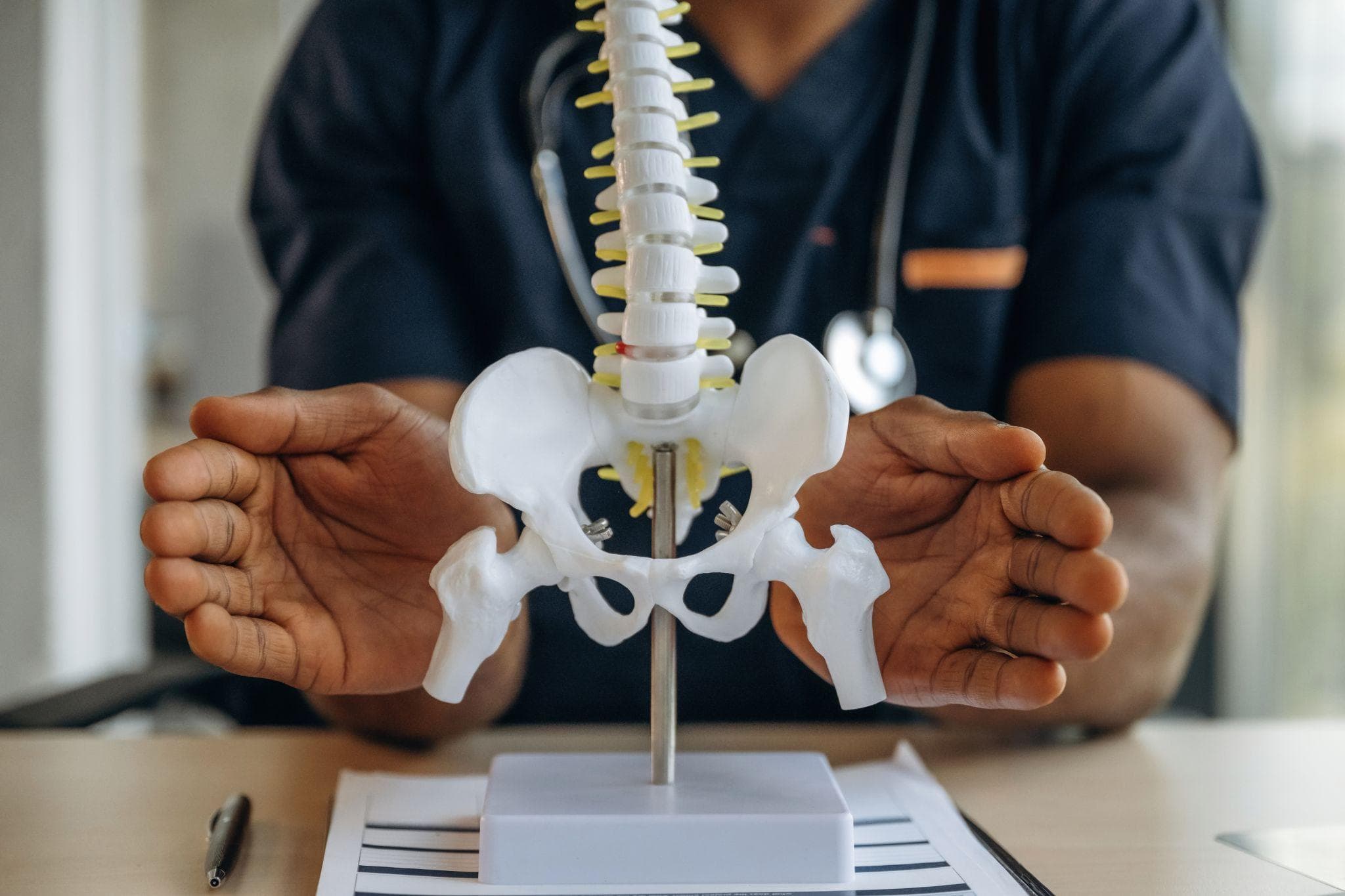
A doctor is presenting a mini model of the spine and hip bones of the body in the clinic.
Recovery after pelvic fracture surgery is not a straight line. Some days feel like progress; others feel like you have gone backwards. That is completely normal. What helps most is knowing what is coming — so you are not blindsided by the slow weeks and you do not push too hard during the ones where you start feeling better.
This guide is for patients who have had — or are about to have — pelvic fracture surgery. It is also for their families, who are often the ones managing the day-to-day reality of recovery and need to know what is reasonable to expect.
Dr. Akash Dubey, MBBS (KGMU, Lucknow), MS, DNB Ortho, Certified Pelvic-Acetabular Surgeon and Member of AOPAS, has treated hundreds of pelvic fracture patients in Greater Noida and across the NCR. The timelines below reflect both clinical evidence and the kind of patient journeys he manages regularly.
Before We Start: Why Pelvic Fracture Recovery Is Different
The pelvis is not like a wrist or a forearm. It is the structural foundation of the entire lower half of your body. Every time you stand, sit, walk, or shift your weight, your pelvis is involved. That is why recovery takes time — not because something is wrong, but because the structure doing the healing is under constant mechanical demand.
After surgery, the metal hardware (plates and screws) provides stability while the bone heals. But the hardware alone is not enough. The muscles and ligaments that attach to the pelvis also need to regain their strength and coordination. And the nervous system — which governs balance, coordination, and how you carry your body weight — needs to recalibrate too.
All of that takes months, not weeks.
A Realistic Recovery Timeline
1. Days 0–3: The Immediate Post-Operative Period
Right after surgery, you will be in the hospital. The first priority is pain control. You will likely have IV pain medication, possibly a nerve block, and the care team will monitor you for signs of bleeding, infection, or clot formation.
The surgical site will be dressed and monitored. You will have a catheter initially. The physiotherapy team typically visits within 24–48 hours after surgery — not to make you walk, but to begin passive ankle movements and breathing exercises to keep clots from forming in the legs.
What to expect: Significant pain and fatigue. Swelling. Difficulty moving in bed. This is completely expected.
2. Week 1–2: Non-Weight-Bearing Begins
You will be discharged from hospital during this period, typically between days 4–7, depending on your overall health and the complexity of the surgery.
At home (or in a rehabilitation facility), the most important rule is: no weight-bearing on the operated side. This is critical. The bone is holding together because of the surgical fixation, but it has not yet started to heal. Putting weight on it too soon can displace the fixation.
You will use a walker or crutches. Your physiotherapist will teach you how to move without loading the pelvis — getting out of bed, using the toilet, moving around the house. These transfers feel awkward and exhausting at first. They get easier.
Wound care is important in this period. Keep the surgical site dry. Watch for signs of infection: increasing redness, warmth, discharge, or fever.
Movements your physio will guide you through:
- Ankle pumps and circles (to prevent clots)
- Deep breathing exercises
- Gentle isometric exercises for the thighs and glutes (tensing without moving)
- Assisted straight leg raises — very small range, very gently
Blood thinners are usually prescribed for 2–6 weeks after surgery to reduce the risk of deep vein thrombosis (DVT). Take them as directed.
Follow-up: Your surgeon will see you at around 10–14 days to check the wound and review X-rays.
3. Week 3–6: Still Non-Weight-Bearing, More Movement
The wound has typically healed by now. Sutures or staples are removed. The pain has usually improved significantly from the first week — though discomfort is still very present, especially when moving.
Physiotherapy becomes more active during this stage. The focus is on hip and knee range of motion exercises for the healing side — passive and gentle. You are still not allowed to load the joint, but controlled movement helps prevent stiffness and muscle wasting.
- Passive hip flexion (your physio moves your leg, you do not do it yourself)
- Assisted knee bending while seated
- Core and upper body strengthening (this matters for when you eventually start walking)
Mentally, this is often the hardest part. The initial adrenaline of getting through surgery has worn off. You cannot drive. You cannot easily do things for yourself. This is the period where many patients report frustration, low mood, and impatience. That is real, and it is worth talking about — both with your care team and with family.
X-ray at 6 weeks: This visit with your surgeon is important. The X-ray at this point will show whether the bone is healing as expected, and whether you can start partial weight-bearing.
4. Week 6–10: Beginning Weight-Bearing
This is when things start to change. Assuming your X-rays look good, your surgeon will give you the go-ahead to begin bearing partial weight through the leg. Not full weight — but touching the foot to the ground and gradually loading it.
This transition is done carefully and under the guidance of your physiotherapist. For most patients, the first few steps with partial weight feel strange — the pelvis has not been loaded for weeks, and the muscles have weakened.
What physiotherapy includes now:
- Assisted standing and walking with crutches or a walker
- Weight-shifting exercises (moving weight gradually from crutches onto the leg)
- Stationary cycling (very light resistance, if tolerated)
- Strengthening exercises for the hip abductors, glutes, and quadriceps
Expect fatigue. Even a 10-minute walk in the clinic corridor may exhaust you at first. That changes fast.

Patient wearing waist band post-surgery.
5. Month 3–4: Building Strength and Independence
By this point, most patients are transitioning from partial to full weight-bearing. Many are walking without crutches — perhaps slowly and with a slight limp, but walking.
The limp at this stage is usually not from pain but from muscle weakness and altered movement patterns that developed during the non-weight-bearing period. This is exactly what physiotherapy addresses now: rebuilding the glutes, hip abductors, and core so the pelvis is stabilised during walking.
Activity restrictions begin to loosen:
- You may be cleared to drive (usually after your surgeon confirms you can react fast enough)
- Light daily activities become manageable
- Swimming or pool walking is often introduced — good for mobility without joint loading
X-ray at 3 months: Bone healing should be well established by this point. Your surgeon will review whether hardware is positioned correctly and if any restrictions can be lifted.
6. Month 4–6: Return to Normal Life
For many patients with straightforward pelvic fractures, this is when life starts to feel somewhat normal again. The limp fades, endurance improves, stairs become manageable, and sitting for longer periods is comfortable.
Manual labour, high-impact activity, or sports return is typically discussed from 4 months onward — and only with surgeon clearance. Returning too early risks re-fracture or hardware failure.
Some patients — particularly those with more complex fractures, bilateral injuries, or significant associated injuries — may take up to 9–12 months to reach this stage. That is not a failure. It is just a longer road.
What Affects Your Recovery Timeline?
Age — Younger patients heal faster. Bone metabolism slows with age.
Fracture complexity — A simple single-fracture is very different from a multi-fragmentary or both-column acetabular fracture. More complex surgery means longer healing.
Overall health — Diabetes, osteoporosis, malnutrition, and smoking all significantly slow bone healing.
Physiotherapy compliance — Patients who attend their sessions and do their home exercises consistently recover faster. It is not just something the clinic asks you to do.
Mental health — Recovery from a traumatic fracture, especially one from a road accident, can involve significant psychological stress. Sleep disturbance, anxiety about re-injury, and depression are all documented after major fractures. Addressing these is part of recovery, not separate from it.
Tips for a Better Recovery at Home in Greater Noida
- Set up your living space before coming home. Move your bed to a lower floor if possible. Clear fall hazards. Get a raised toilet seat if needed.
- Do not skip physio. Even on the days you feel fine — especially on those days.
- Stay on top of nutrition. Bone healing needs calcium, vitamin D, and protein. Many Indian diets are already low in calcium. Consider a supplement — ask your doctor.
- Watch for warning signs. Increasing pain, sudden swelling, redness at the wound site, fever, or inability to bear weight that was possible before — all of these need a call to your doctor.
- Be patient with the emotional side. Recovery from a major fracture is stressful. It changes your independence, your routine, and sometimes your confidence. That deserves attention too.
Frequently Asked Questions
Q1: How long does pelvic fracture surgery recovery take?
For most patients: non-surgical recovery is 3–4 months. Surgical recovery ranges from 4–6 months for straightforward cases, up to 9–12 months for complex fractures or elderly patients.
Q2: When can I walk normally after pelvic surgery?
Most patients begin partial weight-bearing around 6 weeks. Walking without aids is typically possible between 3–4 months, though a full, normal gait often takes longer with physiotherapy.
Q3: Can I do physiotherapy at home after pelvic fracture surgery in Greater Noida?
Yes. Dr. Akash Dubey's clinic provides a structured, week-by-week recovery plan. Home exercises are a core part of that. Your physiotherapist will guide you on what is safe at each stage.
Q4: What are the signs that recovery is not going well?
Sudden increase in pain, new swelling, wound discharge, high fever, or inability to do what was previously possible. Contact your surgeon immediately if any of these happen.
Q5: Will I need the plates and screws removed?
Most pelvic hardware stays in for life and is not routinely removed. However, if it causes discomfort — particularly screws in the posterior pelvis — removal can be considered after 6–12 months, once the bone is fully healed.
Contact Dr. Akash Dubey — Your Bone Mechanic
For personalised pelvic fracture treatment and structured recovery planning in Greater Noida:\
Dr. Akash Dubey
MBBS (KGMU, Lucknow) | MS | DNB Ortho | FIAS | FIJR | FIFA Diploma in Football Medicine
Certified Pelvic-Acetabular Surgeon | Member, AOPAS
Clinic: Shop No. 24, Ground Floor, Gaur City Arcade, Near Sarvodaya Hospital, Gaur City 2, Greater Noida West, U.P. – 201301
To book a consultation, call +91-8130441429