Runner's Knee vs. Jumper's Knee — How to Tell the Difference and What to Do
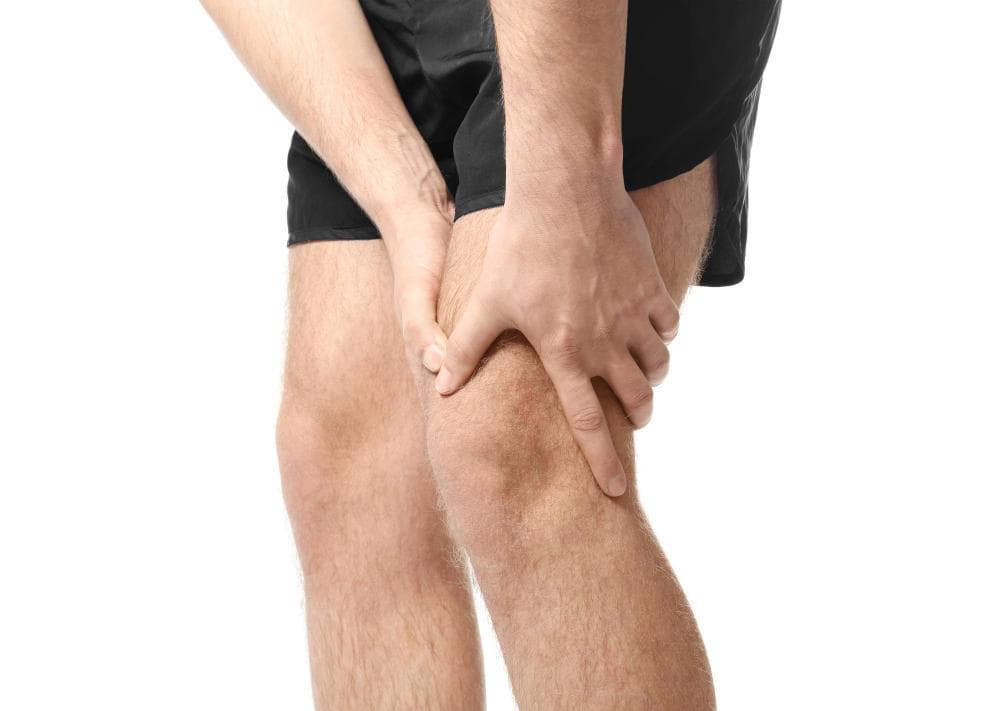
A picture of a young man standing and holding his right knee with both hands as if he were in pain. The man is wearing black shorts, and the background is plain white.
Front knee pain is one of the most common complaints in sports medicine clinics — and one of the most frequently misunderstood. Patients come in describing pain "around the kneecap" or "below the kneecap," having self-diagnosed from the internet, and are often surprised to learn that two entirely different conditions can produce very similar-sounding symptoms.
Runner's knee (patellofemoral pain syndrome) and jumper's knee (patellar tendinopathy) are not the same thing. They affect different structures, have different mechanisms, respond to different treatment approaches, and fail to improve when those approaches are mixed up. Getting the diagnosis right is the starting point for getting better.
The Anatomy You Need to Understand
The kneecap (patella) sits in a groove at the front of the femur (thigh bone) and glides up and down as the knee bends and straightens. The quadriceps muscle attaches to the top of the patella via the quadriceps tendon. Below the patella, the patellar tendon connects it to the tibial tuberosity — the bony prominence at the top of the shin.
Runner's knee is about the patella and the groove it sits in. The problem is abnormal contact between the back of the kneecap and the femur — usually because the patella is not tracking smoothly through its groove as the knee moves.
Jumper's knee is about the patellar tendon below the kneecap. The problem is degeneration or microtearing within the tendon from repetitive tensile loading — most commonly from jumping, landing, and explosive acceleration and deceleration.
Two different structures. Two different problems.
Runner's Knee (Patellofemoral Pain Syndrome): What It Is and Who Gets It
Runner's knee is not just a runner's problem. It affects cyclists, gym athletes, hikers, and anyone doing activity that involves repetitive knee bending. It accounts for 20–40% of all sports medicine knee presentations.
What happens: The patella fails to track smoothly through the femoral groove (the trochlear groove). This can happen because of weak hip abductors (which normally stabilise the pelvis and control thigh rotation), tight iliotibial band, tight lateral retinaculum, weak quadriceps, or flat feet — all of which alter the forces pulling the patella in various directions. When tracking is off, the back of the patella rubs unevenly against the femur, causing pain and inflammation.
Where it hurts: Around and behind the kneecap. The pain is often described as diffuse — hard to pinpoint precisely — and felt behind the kneecap or along its edges.
What makes it worse:
- Prolonged sitting with bent knees (the classic "theatre sign" — pain after sitting through a movie or a long car journey)
- Going down stairs or down slopes
- Squatting
- Running, particularly on hills
What is interesting about runner's knee: Unlike most pain, sitting down with a bent knee sometimes produces a dull aching because the patella is pressed against the femur in this position. A runner might feel more comfortable during the first few minutes of running (when the knee is warming up and moving) than sitting still.
Jumper's Knee (Patellar Tendinopathy): What It Is and Who Gets It
Jumper's knee is a load-related tendon condition. The patellar tendon is subjected to enormous tensile forces during jumping and landing — up to seven times body weight during certain activities. When these forces exceed the tendon's capacity to adapt, microtears develop in the tendon tissue and a degenerative process begins.
It gets the name "jumper's knee" because volleyball, basketball, and athletics (high jump, long jump) are the highest-risk sports. But it also affects cricketers (particularly during bowling and lateral fieldwork), footballers, and gym athletes doing heavy squatting, leg press, and plyometrics.
Where it hurts: Precisely at the lower pole of the patella — the bony tip at the bottom of the kneecap, exactly where the patellar tendon attaches. This is a key distinguishing feature. Patients can often point with one finger to exactly where the pain is.
What makes it worse:
- Loading activities — squatting, jumping, running, particularly going upstairs and up slopes (the opposite of runner's knee)
- The pain typically starts at the beginning of activity, then improves or disappears as the tendon "warms up," then returns after activity and the next morning
The morning stiffness pattern: Many jumper's knee patients describe the worst pain as the first few steps out of bed in the morning, improving within minutes. This warms-up behaviour, followed by post-activity aching, is very characteristic of tendinopathy.
Key Differences at a Glance
| Feature | Runner's Knee (PFPS) | Jumper's Knee (Patellar Tendinopathy) | |---|---|---| | Anatomical location | Around/behind the kneecap | At the lower pole of the patella (tendon attachment) | | Pain quality | Diffuse, hard to pinpoint | Localised — one finger to the spot | | Worse with | Stairs (going down), sitting, squatting | Jumping, squatting (going up), loading activity | | Better with | Usually improves during activity | Often improves DURING activity (warms up) | | Common in | Runners, cyclists, gym athletes | Volleyball, basketball, cricketers, heavy lifters | | Morning stiffness | Possible but not typical | Classic — first steps are worst | | Structure involved | Patellofemoral joint | Patellar tendon |
Treatment: What Works for Each
Runner's Knee Treatment
The primary driver of patellofemoral pain syndrome is a biomechanical problem — altered forces pulling the patella off-track. Treatment targets the underlying causes:
Hip and glute strengthening — Weak hip abductors allow the femur to rotate inward during loading activities, which changes the angle of the patella in its groove. Targeted hip strengthening (clamshells, side-lying leg raises, glute bridges) is the foundation of PFPS rehabilitation.
Quadriceps strengthening — Specifically terminal knee extension and single-leg squat work in a controlled range.
Activity modification — Reducing hill running and stairs temporarily while the condition is managed.
Running technique — Increasing step rate (cadence), reducing overstriding, and improving landing mechanics all reduce patellofemoral forces during running.
Insoles and footwear — Flat feet contribute to PFPS in some patients. Appropriate arch support reduces the valgus knee stress during running.
What does NOT help: Prolonged rest. Sitting still lets the muscles weaken further and does not resolve the underlying biomechanical problem. Progressive, guided rehabilitation is what works.
Jumper's Knee Treatment
Tendinopathy is treated very differently from PFPS. The key intervention is loading — progressive, heavy, slow loading of the tendon to stimulate adaptation.
Heavy slow resistance training — Exercises like the Spanish squat (back against wall, feet forward), leg extension machine, and slow single-leg decline squat are the evidence-based core treatment. Eccentric exercise (the lowering phase of a squat) used to be the gold standard; current evidence now supports heavy slow concentric-eccentric combined loading.
Load management — The training volume that caused the problem needs to be reduced temporarily. Not eliminated entirely — but brought to a level the tendon can manage while adaptation occurs.
NSAIDs — Anti-inflammatory medications help with pain during the acute phase but do not change the tendon pathology. They are symptomatic management only.
Shockwave therapy — Extracorporeal shockwave therapy has reasonable evidence for chronic patellar tendinopathy not responding to loading exercise. It stimulates a healing response in the degenerated tendon tissue.
PRP injection — For recalcitrant cases that have not improved after 3–4 months of well-supervised loading exercise, PRP injection provides a biological stimulus to the degenerated tissue. Results are variable but the evidence is more convincing for tendinopathy than many other applications.
What does NOT help: Complete rest. Tendons need load to adapt. Complete offloading actually makes tendinopathy worse — the tendon loses the mechanical stimulus for regeneration. The goal is to find the load level the tendon can handle and progressively increase from there.
When to See a Specialist in Greater Noida
Most cases of both runner's knee and jumper's knee will improve with the right physiotherapy programme within 6–12 weeks. A physiotherapist experienced in sports injuries can manage these conditions effectively.
See Dr. Akash Dubey at your Bone Mechanic clinic in Gaur City 2 if:
- Symptoms are not improving after 8–10 weeks of properly guided rehabilitation
- The diagnosis is unclear — you are not sure which condition you have
- You need imaging (ultrasound or MRI) to confirm the diagnosis or rule out other pathology (a meniscal tear or early arthritis can produce similar symptoms)
- You are considering injection therapy (PRP or cortisone) as part of your treatment plan
- Symptoms are preventing you from performing at your level in your sport
Frequently Asked Questions
Q: Can you have runner's knee and jumper's knee at the same time?
It is possible but not common. The pain locations are distinct — behind the kneecap (PFPS) vs. at the bottom of the kneecap (tendinopathy) — which helps distinguish them. If you genuinely cannot identify which one you have, see a specialist.
Q: Does runner's knee go away on its own?
It can, if the aggravating activity stops. But without addressing the underlying biomechanical cause (typically hip weakness), it tends to return when training resumes. Treat the cause, not just the symptom.
Q: Is cortisone injection useful for jumper's knee?
It provides short-term pain relief but does not treat the tendon degeneration — and in some studies, cortisone around tendons has been associated with weakening of the tendon structure. It is generally avoided for patellar tendinopathy.
Q: How long does jumper's knee take to recover?
Mild to moderate cases typically improve in 6–12 weeks with proper loading exercise. Chronic, well-established tendinopathy can take 3–6 months. It is a slow condition that rewards patience and consistent work.
Contact Dr. Akash Dubey — Your Bone Mechanic
Dr. Akash Dubey
MBBS (KGMU, Lucknow) | MS | DNB Ortho | FIAS | FIJR | FIFA Diploma in Football Medicine
Robotic Surgery Certified | Member, AOPAS
Clinic: Shop No. 24, Ground Floor, Gaur City Arcade, Near Sarvodaya Hospital, Gaur City 2, Greater Noida West, U.P. – 201301
To book a knee pain consultation in Greater Noida, call +91-8130441429