Shoulder Dislocation in Athletes: Immediate Steps and Long-Term Treatment in Greater Noida
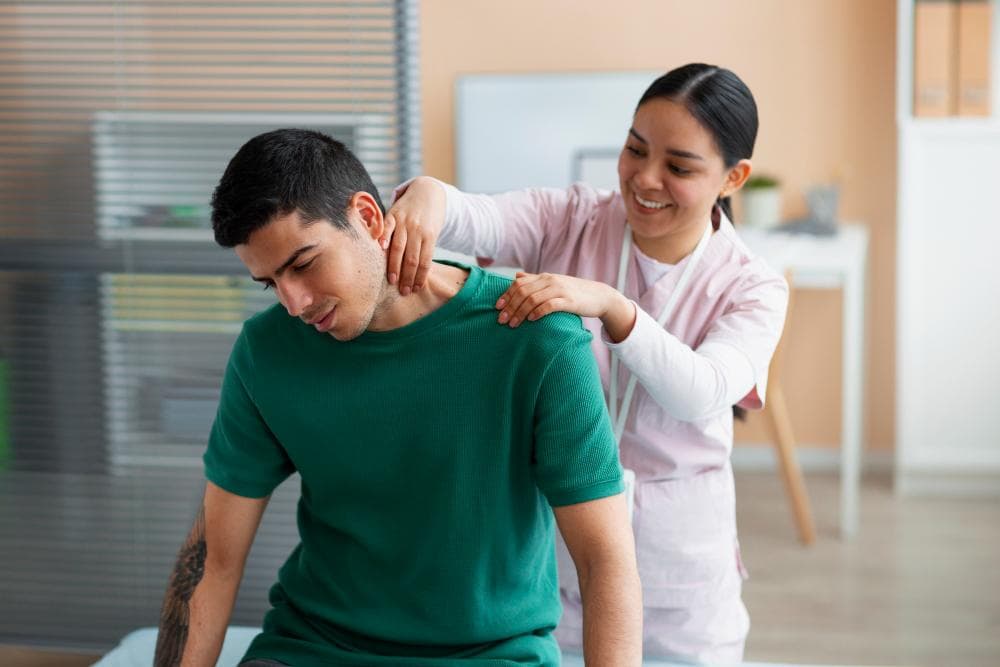
A healthcare professional with dark hair, wearing a pink uniform, is smiling as they massage the shoulder of a man in a green shirt. The man appears relaxed but slightly pained, leaning forward with a neutral expression.
A dislocated shoulder is one of the most dramatic sports injuries. One moment the player is diving for a catch or absorbing a tackle; the next, the arm is held at an awkward angle, the shoulder has an obvious deformity, and the pain is severe enough to stop everything.
It is also one of the most mismanaged sports injuries. Athletes have the shoulder reduced (put back into place), are told to rest for a few weeks, and return to sport — only to dislocate again, and again, until the joint has accumulated enough structural damage that a relatively straightforward initial surgery has become a complex reconstruction.
This article covers what to do immediately after a shoulder dislocation, how it is assessed and managed, who needs surgery, and what realistic prevention looks like.
What Happens When the Shoulder Dislocates
The shoulder is the most mobile joint in the body. That mobility comes at the cost of stability — the shoulder relies far more on soft tissue structures than on bony containment to hold the ball in the socket.
When the shoulder dislocates anteriorly (the most common direction — the ball comes out to the front), the labrum — the fibrocartilage rim of the socket — tears away from the front of the glenoid. This is a Bankart lesion. It is present in the vast majority of first-time anterior dislocations.
At the same time, the ball of the humerus may get dented where it strikes the glenoid rim — this is a Hill-Sachs lesion. With repeated dislocations, bone is progressively lost from both the glenoid socket and the humeral head.
Each dislocation causes more structural damage. The recurrence risk after a first dislocation is high — up to 70–90% in young athletes under 25 in contact sports.
Immediate Management: The First Hours Matter
1. On the Field
If you witness a shoulder dislocation on the field, the priorities are:
-
Immobilise the arm. Do not attempt to reduce (put back in place) the shoulder on the field without proper assessment and appropriate technique. Uninformed attempts at reduction risk fracturing the humeral head, damaging the axillary nerve, or making the injury worse.
-
Remove from play. The player should not return to the game that day. The shoulder needs imaging before further activity.
-
Assess neurovascular status. Is there any numbness or tingling in the arm? Can the player move their fingers? Is the hand warm? The axillary nerve (which runs close to the joint) is at risk during dislocation and may be temporarily affected.
-
Go to a medical facility for reduction. Shoulder dislocation is reduced under proper supervision — with adequate analgesia and muscle relaxation, either in the emergency department or by a sports medicine physician with the appropriate training.
2. The Reduction
Reduction means manipulating the humeral head back into the glenoid socket. Several techniques exist (Cunningham, Milch, scapular manipulation, traction-countertraction). Done well, the shoulder reduces smoothly with minimal force. Done poorly — with too much force or without adequate muscle relaxation — it risks avulsion fractures, nerve injury, or failure to reduce.
After reduction, X-ray confirms the joint is back in position and identifies any associated fractures (the greater tuberosity occasionally fractures with dislocation and must not be missed).
3. Post-Reduction
A sling for comfort, not immobilisation for weeks. Ice for 24–48 hours. Early gentle range-of-motion is initiated — in consultation with the treating surgeon or physiotherapist — to prevent stiffness.
MRI after first dislocation — This is important and often neglected. A first-time dislocation that was managed in an emergency department and discharged with "rest for 2 weeks" does not include an MRI of the shoulder. But MRI after the acute phase reveals the labral damage, identifies any associated rotator cuff injuries (more common in patients over 40), and provides the information needed to make the right treatment decision.
Who Needs Surgery After a Shoulder Dislocation?
This is the critical question — and the answer is more nuanced than "first dislocation = no surgery, second dislocation = surgery."
1. Factors Favouring Earlier Surgery (After First Dislocation)
Age under 25 in contact or overhead sport. The recurrence rate in this group without surgery is 70–90%. The structural damage from each subsequent dislocation is cumulative. Operating after the first episode — before bone loss occurs — produces better results than waiting for multiple dislocations.
Significant bony deficiency. If MRI shows a large Hill-Sachs lesion or glenoid bone loss after the first dislocation, conservative management is unlikely to prevent recurrence. Bone loss changes the treatment algorithm entirely — procedures that require bone grafting (Latarjet procedure) may be needed.
Patient preference and sport demands. An athlete in a collision sport (wrestling, rugby, football, martial arts) who is fully informed about the recurrence risk may reasonably choose early surgery rather than the risk of repeated dislocations during the season.
2. Factors Where Initial Non-Operative Management Is Reasonable
- First dislocation in an older recreational athlete (over 40) — recurrence risk is lower with age
- First dislocation without significant glenoid bone loss in a non-contact sport
- Patient who prefers to try rehabilitation and monitor
3. The Evidence
A systematic scoping review published in 2025 (Journal of Clinical Medicine) found that surgical stabilisation produces better outcomes than conservative management in terms of recurrence rates and return to sport, particularly in young athletes. For young contact-sport athletes, earlier surgery may reduce cumulative joint damage compared to waiting through multiple dislocations.
Surgical Treatment: Arthroscopic Bankart Repair
For patients with a Bankart lesion and without significant glenoid bone loss, arthroscopic Bankart repair is the standard procedure.
The torn labrum is reattached to the glenoid rim using small suture anchors. The capsule is tightened. In many cases, a remplissage (filling the Hill-Sachs lesion with part of the posterior capsule) is added to prevent the lesion from engaging on the glenoid rim during arm elevation.
Post-operative protocol:
- Sling for 4–6 weeks
- Physiotherapy begins at 2 weeks with pendulum exercises and gentle passive motion
- Active motion from 6 weeks
- Return to non-contact sport: 4–6 months
- Return to contact sport: 6–9 months, with successful return-to-sport criteria
When More Is Needed: The Latarjet Procedure
When significant glenoid bone loss is present (typically more than 25% of glenoid width), arthroscopic Bankart repair alone has a high failure rate — the soft tissue repair cannot compensate for missing bone.
The Latarjet procedure transfers a piece of bone (the coracoid process) to the front of the glenoid socket, creating a bony buttress that physically prevents the humeral head from dislocating forward. It is a more complex procedure than Bankart repair but produces excellent stability outcomes in patients with significant bone loss.
Shoulder Dislocation Rehabilitation
Whether management is surgical or non-operative, structured rehabilitation is non-negotiable.
Phase 1 (weeks 0–6): Sling. Pendulum exercises. Isometric strengthening of scapular stabilisers.
Phase 2 (weeks 6–12): Active range-of-motion restoration. Rotator cuff strengthening — internal and external rotation. Scapular strengthening.
Phase 3 (months 3–5): Sport-specific strengthening. Overhead athletes begin light throwing or serving programmes. Contact sport athletes begin progressive body contact.
Return to sport testing: Shoulder strength, proprioception, and psychological readiness are all assessed before return to competitive sport. Athletes returning before adequate strength has been restored have higher rates of recurrence.
Frequently Asked Questions
Q1: My shoulder went back in on its own after dislocating. Does it still need medical attention?
Yes. A spontaneous reduction (the shoulder goes back without formal reduction) still means the labrum has torn and the structural damage has occurred. It still needs imaging and proper assessment.
Q2: If I have surgery, will my shoulder be as strong and mobile as before?
For most athletes with a first-time dislocation and minimal bone loss, arthroscopic Bankart repair produces excellent results — 84% of patients return to sport at previous or higher levels in some studies. Some mild reduction in external rotation range can occur and may affect overhead or throwing athletes.
Q3: Is shoulder dislocation surgery available in Greater Noida?
Yes. Dr. Akash Dubey performs arthroscopic Bankart repair at KDSG Superspeciality Hospital, Greater Noida.
Q4: How long after a shoulder dislocation should I wait before seeing a specialist?
Within 1–2 weeks of the dislocation, after the initial swelling has reduced and the acute pain is manageable. Early assessment allows MRI to be done in the appropriate time window and ensures nothing is missed.
Contact Dr. Akash Dubey — Your Bone Mechanic
Dr. Akash Dubey
MBBS (KGMU, Lucknow) | MS | DNB Ortho | FIAS | FIJR | FIFA Diploma in Football Medicine
Robotic Surgery Certified | Member, AOPAS
Clinic: Shop No. 24, Ground Floor, Gaur City Arcade, Near Sarvodaya Hospital, Gaur City 2, Greater Noida West, U.P. – 201301
To book a consultation for shoulder dislocation in Greater Noida, call +91-8130441429