Top 5 Sports Injuries Dr. Akash Treats Most Often in Greater Noida — and How
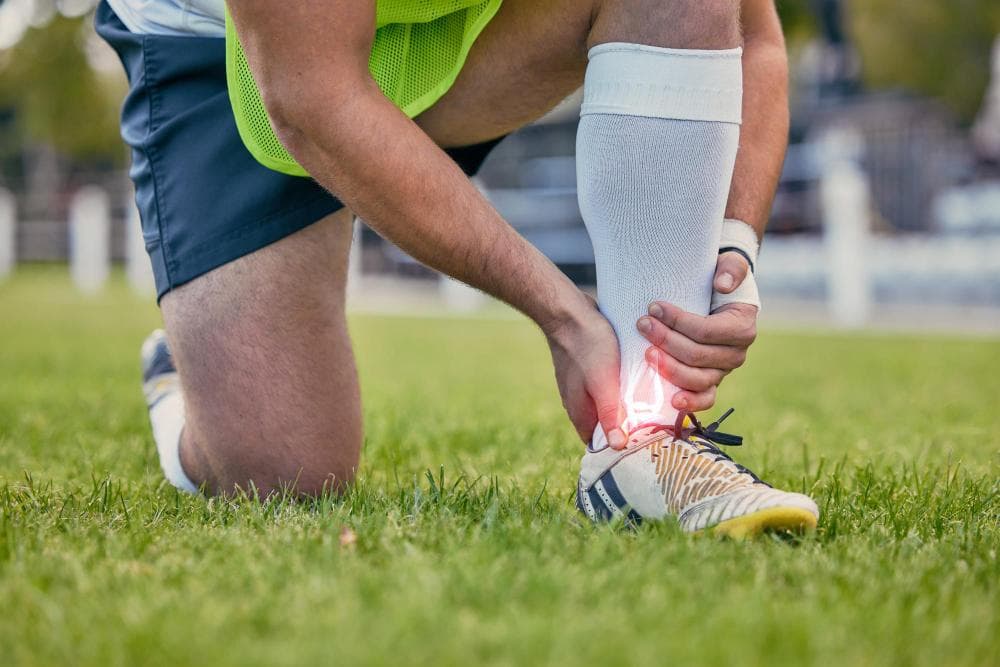
A male soccer player kneels on the grass, gripping his ankle with both hands and showing a pained expression. The area around his ankle is highlighted in red, indicating injury. The background features a blurred field and goalposts.
Greater Noida and the surrounding NCR have a growing, active population — gym enthusiasts, cricketers, footballers, marathon runners, badminton players, and weekend athletes of every kind. With that activity comes injury. Some of these injuries are minor and resolve with rest and physio. Others — if mismanaged or ignored — turn into something much more significant.
Dr. Akash Dubey, MBBS (KGMU, Lucknow), MS, DNB Ortho, FIAS, FIFA Diploma in Football Medicine, sees sports-related orthopaedic injuries regularly at his Your Bone Mechanic clinic in Gaur City 2, Greater Noida West. These are the five he encounters most often — and what the management actually involves.
1. ACL Tears (Anterior Cruciate Ligament)
The most discussed sports injury in orthopaedics, and for good reason. The ACL is the central stabilising ligament of the knee — the structure that prevents the tibia from sliding forward during pivoting, cutting, and landing movements. Cricket, football, kabaddi, badminton, and basketball all create the right conditions for an ACL tear.
The injury typically happens without contact — a sudden deceleration, a change of direction, or an awkward landing — followed by an immediate pop, rapid swelling, and the knee giving way. Most patients say they knew something serious had happened the moment it occurred.
What Dr. Akash does:
Clinical examination and MRI confirm the diagnosis. For active patients wanting to return to sport, arthroscopic ACL reconstruction — using the patient's own hamstring tendon as a graft — is the standard. Surgery is planned 3–6 weeks after the injury once swelling resolves and quad function returns. Return to sport: 9–12 months with a structured rehabilitation programme.
2. Meniscal Tears
Closely related to ACL injuries — meniscal tears frequently accompany ACL ruptures, but they also occur independently from twisting injuries during sport. The meniscus is the C-shaped cartilage cushion between the femoral and tibial surfaces of the knee. When it tears, patients report knee pain, swelling, and sometimes a locking sensation — the knee getting stuck at a specific angle.
What Dr. Akash does:
Assessment includes clinical provocation tests and MRI to classify the tear. The approach depends entirely on the type and location:
- Traumatic tears in younger athletes with good tissue quality in the vascular zone: arthroscopic repair (stitching the meniscus) where possible.
- Irreparable tears causing locking or mechanical symptoms: partial meniscectomy (trimming the damaged fragment).
- Degenerative tears in older patients without mechanical symptoms: structured physiotherapy first; surgery only if symptoms persist at 6–8 weeks.
3. Rotator Cuff Injuries (Shoulder)
The shoulder is the most mobile joint in the body and takes enormous rotational demand in overhead sports — cricket bowling and throwing, badminton, swimming, and volleyball. The rotator cuff — four muscles and their tendons wrapping around the humeral head — is the primary stabiliser of the shoulder during these movements.
Rotator cuff injuries range from mild inflammation (rotator cuff tendinopathy) to partial tears to full-thickness tears where the tendon has completely detached from the bone. The presentation is shoulder pain with overhead activity, weakness when lifting the arm, and sometimes an inability to sleep on the affected side.
What Dr. Akash does:
Clinical examination, X-ray, and MRI establish the diagnosis and extent of injury. Management ranges from physiotherapy and injection for mild tendinopathy, to arthroscopic repair for significant partial or complete cuff tears. Recovery after arthroscopic cuff repair: 9–12 months for overhead sport return.
4. Ankle Sprains and Ligament Injuries
Ankle sprains are the most common sports injury globally — and among the most underestimated. The lateral ligament complex (ATFL and CFL most commonly) is torn when the foot inverts suddenly, rolling inward under the ankle.
The injury happens in virtually every sport: a misstep on an uneven field, landing awkwardly from a jump, a sudden change of direction. Most people dismiss ankle sprains as minor and return to activity too quickly. This leads to ligament laxity, chronic instability, and repeated sprains that compound the damage over time.
What Dr. Akash does:
Clinical assessment uses the Ottawa Ankle Rules to determine whether X-ray is needed to exclude fracture. Most ankle sprains are managed conservatively — RICE (Rest, Ice, Compression, Elevation), physiotherapy for proprioception and peroneal muscle strengthening, and graduated return to activity.
Chronic instability — where the ankle gives way repeatedly despite conservative management — is assessed with stress imaging. Lateral ligament reconstruction (arthroscopic or open Brostrom procedure) is considered when instability persists and is affecting athletic performance.
5. Patellar Tendinopathy and Anterior Knee Pain
Patellar tendinopathy (jumper's knee) and patellofemoral pain syndrome (runner's knee) together account for a large proportion of overuse sports injuries seen in Dr. Dubey's clinic. These are fundamentally training-load injuries — they develop when the body's tissue capacity is exceeded by training demands.
Jumper's knee affects volleyball players, basketball players, and cricketers who spend significant time bowling or batting in crouched positions. Runner's knee affects long-distance runners, cyclists, and gym athletes. Both cause anterior knee pain that interferes with training, competition, and daily activities.
What Dr. Akash does:
Diagnosis is clinical, confirmed with ultrasound or MRI where needed. The management is almost always non-surgical initially: load management, physiotherapy (heavy slow resistance exercises are the evidence-based intervention for patellar tendinopathy), shockwave therapy in select cases, and PRP injection for recalcitrant cases that have not responded to 3–4 months of well-supervised conservative treatment.
Surgery for patellar tendinopathy is very rarely needed. When it is performed — for chronic, degenerative tendon changes unresponsive to all conservative measures — it involves arthroscopic debridement of the affected tendon tissue.
The Common Thread
What connects all five of these injuries is something that never changes: early, accurate diagnosis produces better outcomes than delayed assessment. Patients who see a sports injury specialist within the first 1–2 weeks of injury consistently have more treatment options, clearer recovery timelines, and return to sport faster than those who wait months managing pain with rest alone.
At Your Bone Mechanic clinic in Gaur City 2, Greater Noida West, the first appointment is built around establishing a precise diagnosis — not a vague "rest and see what happens" plan. From there, the treatment pathway is explained, realistic return-to-sport timelines are discussed, and the patient is guided through every stage of recovery.
Frequently Asked Questions
Q: How do I know if my sports injury needs a specialist or if physio alone is enough?
A good physiotherapist will refer you to an orthopaedic specialist if there is joint instability, suspected ligament or meniscal injury, or symptoms not improving after 4–6 weeks of treatment. Do not wait longer than that before seeking further assessment.
Q: Is surgery always required for an ACL tear?
Not always. Older, less active patients with a partial ACL tear and minimal instability can sometimes manage without surgery. For younger athletes wanting to return to cutting sports, reconstruction gives the most reliable outcome.
Q: Can I prevent sports injuries with the right training?
Injury prevention programmes — like the FIFA 11+ for footballers and structured strength and conditioning — measurably reduce injury rates. Adequate warm-up, load management, and sleep and recovery are the most impactful modifiable factors.
Q: Does Dr. Akash Dubey treat non-surgical sports injuries too?
Yes. The majority of sports injury consultations result in a non-surgical plan — physiotherapy, injection, activity modification. Surgery is recommended when it is genuinely the best option, not as a default.
Contact Dr. Akash Dubey — Your Bone Mechanic
Dr. Akash Dubey
MBBS (KGMU, Lucknow) | MS | DNB Ortho | FIAS | FIJR | FIFA Diploma in Football Medicine
Robotic Surgery Certified | Member, AOPAS
Clinic: Shop No. 24, Ground Floor, Gaur City Arcade, Near Sarvodaya Hospital, Gaur City 2, Greater Noida West, U.P. – 201301
To book a sports injury consultation in Greater Noida, call +91-8130441429