What Is Knee Arthroscopy and Do You Actually Need It? A Simple, Honest Guide
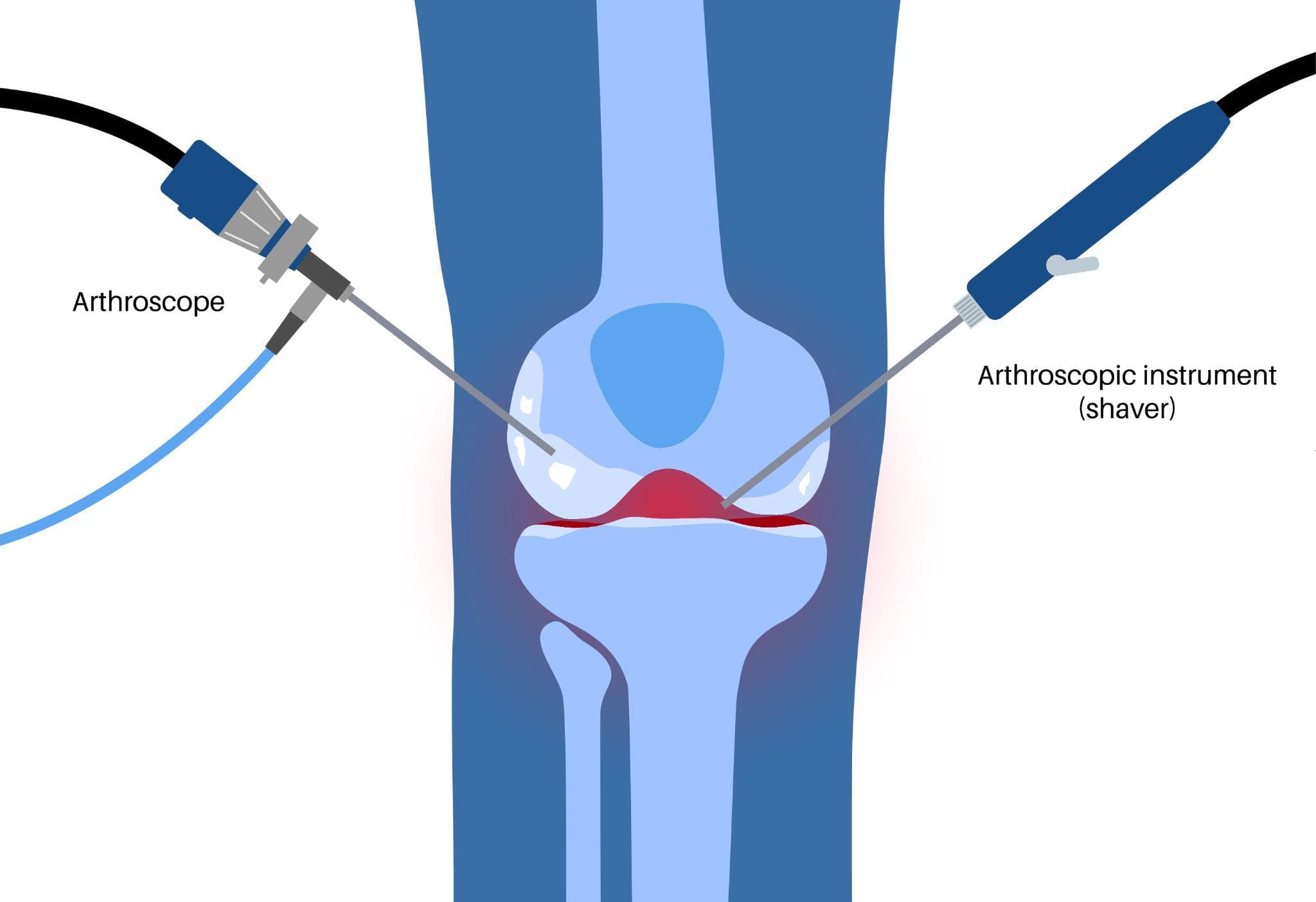
Medical illustration of knee arthroscopy procedure showing an arthroscope and surgical shaver inserted into the knee joint.
The word arthroscopy sounds technical and intimidating. In reality, it describes a fairly elegant idea: instead of making a large incision to look inside a joint, the surgeon makes two or three small punctures — each about half a centimetre — and inserts a pencil-thin camera. The joint appears on a monitor in magnified detail. If something needs fixing, slender instruments go in through the other portals and the work gets done with minimal disruption to the surrounding tissue.
That's the concept. Whether you personally need it is a different question — and one that gets oversimplified too often in both directions. Some patients are pushed toward arthroscopy prematurely, before conservative treatment has had a fair chance. Others who genuinely need it wait far too long because nobody put a clear picture in front of them.
This article explains what knee arthroscopy is, what it can and cannot fix, and how to know whether it belongs in your treatment plan.
What the Procedure Actually Involves
Knee arthroscopy is an outpatient procedure — you go home the same day. It is performed under spinal or general anaesthesia (sometimes regional nerve block), typically takes 30–90 minutes depending on what needs to be done, and uses instruments so small that the incision sites are often closed with a single stitch or steri-strips.
Here is what happens
The surgeon inflates the knee joint slightly with saline solution, which creates space and improves visibility. The arthroscope — a thin tube with a camera and light — is inserted through the first portal. The camera feeds live, high-definition images to a monitor. The surgeon examines every structure inside the joint: the articular cartilage, both menisci, the cruciate ligaments, the synovial lining, and the joint spaces between the bones.
If something is found that can be treated — a torn meniscus, loose cartilage, an inflamed synovium, a partial ligament tear — instruments are inserted through the additional portals to address it. The repair or removal happens under direct arthroscopic visualisation.
What Knee Arthroscopy Can Treat
The list of conditions treatable through arthroscopy is substantial:
1. Meniscal tears — Tears of the C-shaped cartilage cushions between the femur and tibia. Depending on the location and type of tear, the surgeon either trims the damaged portion (partial meniscectomy) or repairs it with sutures.
2. ACL injuries — Arthroscopy is integral to both ACL repair (reattaching the torn ligament with sutures) and ACL reconstruction (replacing the torn ligament with a graft).
3. Loose bodies — Fragments of cartilage or bone floating inside the joint after an injury or in advanced arthritis. These cause locking, catching, and sharp pain with movement. Arthroscopy removes them efficiently.
4. Chondral damage — Damage to the articular cartilage covering the joint surfaces. Procedures like microfracture (creating small holes in subchondral bone to stimulate cartilage repair) or chondroplasty (smoothing damaged cartilage edges) are performed arthroscopically.
5. Synovitis — Inflammation and thickening of the joint lining, seen in inflammatory arthritis, infection, or injury. Arthroscopic synovectomy removes the inflamed tissue.
6. Patellar tracking problems — Conditions where the kneecap runs off-track in its groove. Lateral release — cutting the tight tissue on the outer side — can be done arthroscopically.
7. Plica syndrome — A painful fold of synovial tissue that sometimes catches on joint structures.
What Knee Arthroscopy Cannot Fix
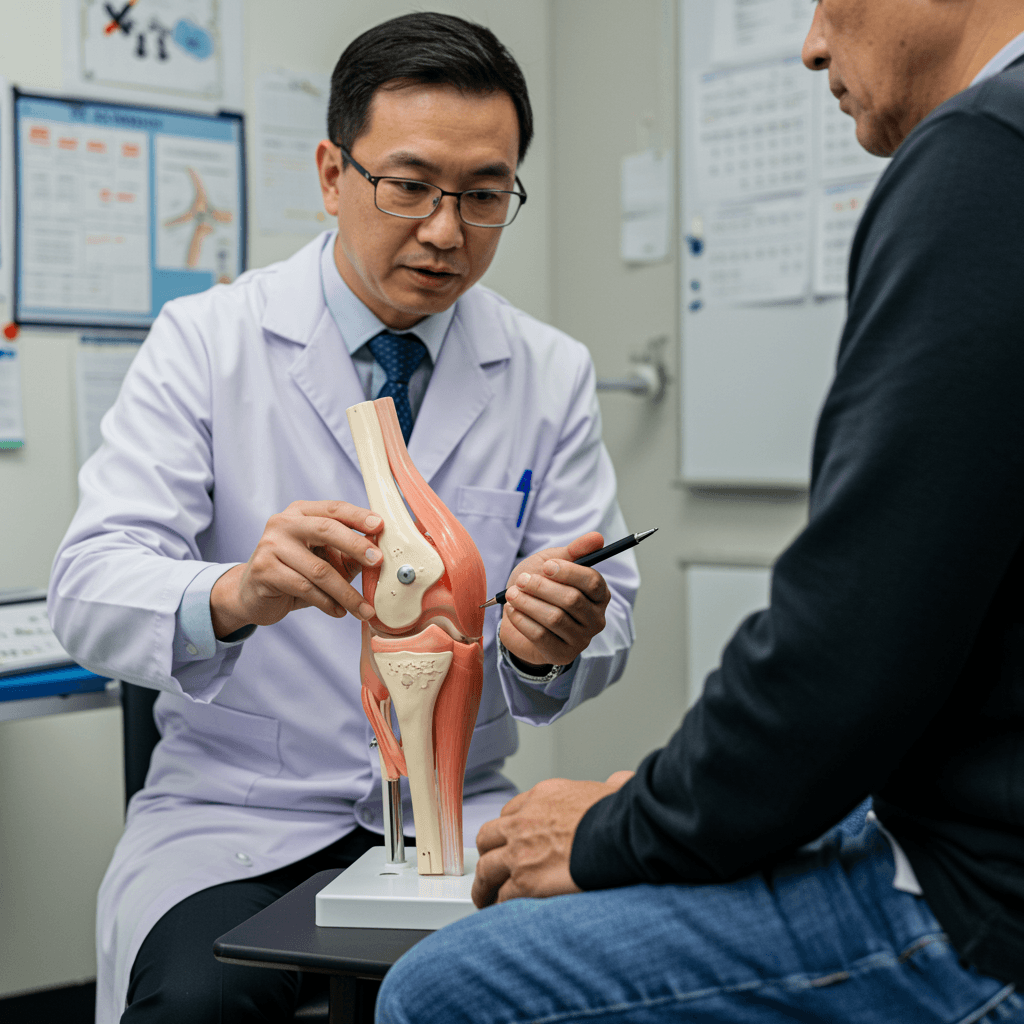
An orthopedic doctor explaining knee joint anatomy to a patient during consultation.
This is the part that often gets skipped in patient conversations.
Advanced osteoarthritis — Once the cartilage is significantly worn and bone is rubbing on bone, arthroscopy provides at best short-term relief in some patients, and no meaningful long-term benefit in most. Multiple large randomised trials have shown that arthroscopy for isolated knee osteoarthritis is no better than conservative treatment or even sham surgery in terms of pain and function at 6–12 months. This does not mean arthroscopy should never be performed in arthritic knees — but it should not be performed because of arthritis. The indication must be something specific (a torn meniscus, a loose body) rather than general joint degeneration.
Old, chronic ligament injuries with significant instability — A ligament that has been completely torn for years, with established instability and secondary changes, may need reconstruction rather than repair. Arthroscopy can assess this, but not always fix it.
Structural deformity — Bow-legs or knock-knees that are driving the joint damage need osteotomy (realignment surgery), not arthroscopy. Scoping such joints without addressing the underlying alignment is like patching a tyre without removing the nail.
When Arthroscopy Is the Right Answer
The clearest indications for knee arthroscopy are:
Mechanical symptoms — locking (the knee suddenly gets stuck in one position), catching (a sharp sensation like something snapping inside the joint), or persistent giving way. These symptoms often indicate loose cartilage or a displaced meniscal tear that will not respond to physiotherapy.
Acute ligament injuries in active patients — Particularly ACL tears in younger athletes who want to return to cutting or pivoting sports. Reconstruction via arthroscopy gives the most reliable return-to-sport outcome.
Confirmed meniscal tear with mechanical symptoms that have not responded to 6–8 weeks of structured physiotherapy — For degenerative tears in older patients, physiotherapy should be tried thoroughly first. For traumatic tears with locking in younger patients, the threshold for surgery is lower.
Diagnostic arthroscopy — Occasionally, the imaging does not provide a definitive answer. Arthroscopy can clarify the diagnosis directly.
What You Should Expect at Dr. Akash Dubey's Clinic
When you come to Your Bone Mechanic clinic at Gaur City 2, Greater Noida West with knee pain, the approach is to establish exactly what is causing it before recommending any procedure. Dr. Akash Dubey — MBBS (KGMU, Lucknow), MS, DNB Ortho, FIAS, with a Fellowship in Arthroscopy and Sports Surgery — reviews your imaging, performs a structured examination, and explains what the findings mean.
Arthroscopy is recommended when the evidence supports it — not as a first resort and not because it is convenient. The conversation is honest about what it will and will not achieve in your specific case.
Frequently Asked Questions
Q: Is knee arthroscopy major surgery?
It is a surgical procedure under anaesthesia, but it is minimally invasive. Most patients go home the same day, walk within hours, and return to light activity within days to weeks. It is significantly less disruptive than open surgery.
Q: Will I need physiotherapy after knee arthroscopy?
Yes. Exercise rehabilitation after arthroscopy is essential — particularly for strengthening the quadriceps and restoring full range of motion. Without it, recovery is slower and outcomes are less reliable.
Q: Is knee arthroscopy available in Greater Noida?
Yes. Dr. Akash Dubey holds a Fellowship in Arthroscopy and Sports Surgery (FIAS) and performs arthroscopic procedures at KDSG Superspeciality Hospital, Greater Noida.
Q: How long after arthroscopy can I return to work?
Desk work: often within 1–2 weeks. Physical work: 4–6 weeks minimum. Sport-specific return depends on the procedure — from 4 weeks for minor procedures to 9–12 months for ACL reconstruction.
Q: Can knee arthroscopy be done if I have diabetes or hypertension?
With adequate pre-operative control of blood sugar and blood pressure, yes. Poorly controlled diabetes significantly increases infection risk. Pre-operative medical optimisation is part of the workup.
Contact Dr. Akash Dubey — Your Bone Mechanic
Dr. Akash Dubey
MBBS (KGMU, Lucknow) | MS | DNB Ortho | FIAS | FIJR | FIFA Diploma in Football Medicine
Robotic Surgery Certified | Member, AOPAS
Clinic: Shop No. 24, Ground Floor, Gaur City Arcade, Near Sarvodaya Hospital, Gaur City 2, Greater Noida West, U.P. – 201301
To book a consultation for knee arthroscopy in Greater Noida, call +91-8130441429