What Is Partial Knee Replacement and Who Is the Right Candidate?
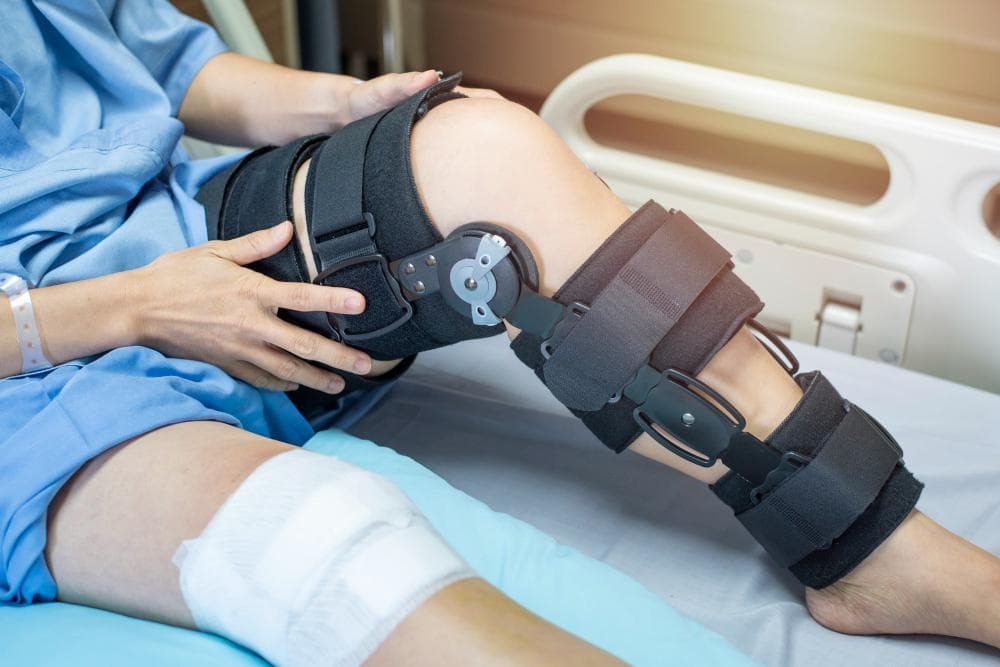
A patient is lying down in the hospital room post-surgery and is wearing a knee brace for proper recovery.
When people hear "knee replacement," they usually picture total knee replacement — the entire joint surface being replaced with metal and plastic. But there is another option that gets significantly less attention: partial knee replacement, or unicompartmental knee arthroplasty (UKA).
For the right patient, partial knee replacement offers real advantages over total replacement — faster recovery, better function, and a knee that feels more like your own. But it is not appropriate for everyone. The condition of the knee and the specific damage pattern determine whether partial replacement is even possible.
This article explains what partial knee replacement is, who qualifies, what the advantages are over total replacement, and what the honest limitations are.
Understanding the Knee's Three Compartments
The knee joint is divided into three compartments:
Medial compartment — the inner side of the knee (closest to the other knee). This is the compartment that wears out most commonly, particularly in patients with bow-legged alignment (varus deformity).
Lateral compartment — the outer side of the knee. Less commonly affected.
Patellofemoral compartment — the joint between the kneecap (patella) and the front of the thigh bone. Can be isolated in cases of patellofemoral arthritis.
In a total knee replacement, all three compartments are replaced. In a partial replacement, only one compartment is addressed — the others are left completely intact.
What Partial Knee Replacement Involves
During a partial knee replacement, the surgeon removes the damaged cartilage and bone only in the affected compartment, then places a small metal cap on each bone surface in that compartment with a thin plastic spacer between them.
Because only one part of the knee is operated on, the incision is smaller, less bone and tissue are disturbed, and the cruciate ligaments (ACL and PCL) are preserved. The healthy cartilage, bone, and ligaments in the other two compartments remain completely untouched.
This is why partial knee replacement — when correctly indicated — feels more natural to patients. The knee retains its original ligament-based stability and much of its original proprioception (sense of joint position), rather than relying entirely on the artificial construct.
Who Is the Right Candidate?
This is the most important part, and it is worth being very specific.
1. Patients Who Benefit from Partial Knee Replacement
Single compartment arthritis — The damage must be limited to one compartment. If the patient has bone-on-bone arthritis in the medial compartment but relatively healthy lateral and patellofemoral cartilage, partial replacement addresses the problem without over-treating the knee.
Intact cruciate ligaments — Partial knee replacement requires a functioning ACL (and ideally PCL) to maintain joint stability. If the ACL is deficient, partial replacement is generally not appropriate.
Correctable deformity — Mild bow-leg or knock-knee alignment is manageable, but severe deformity typically requires a total replacement to correct the alignment across the whole joint.
No significant inflammatory arthritis — Conditions like rheumatoid arthritis affect the entire joint, not just one compartment, making partial replacement inappropriate.
Appropriate weight and activity level — Partial replacements can handle most daily activities well. Patients who are very obese or who plan to return to very high-impact activities are at higher risk of early failure.
Age — Partial replacement is often particularly well-suited to younger active patients who want to preserve as much natural joint as possible, and to older patients who want a faster recovery. Both ends of the spectrum can benefit, though for different reasons.
2. Who Is Not a Good Candidate
- Arthritis involving two or three compartments
- Absent or significantly deficient ACL
- Large deformity that cannot be passively corrected
- Inflammatory arthritis (rheumatoid, psoriatic, etc.)
- Prior high tibial osteotomy in some cases
Approximately 10–15% of patients presenting with knee arthritis are genuinely good candidates for partial replacement. It is a minority of all knee replacement patients — not because it is inferior but because most patients who present to clinic have more widespread disease.
Advantages of Partial Over Total Knee Replacement
1. Faster Recovery
The procedure is less invasive. Smaller incision, less blood loss, less muscle disruption. Most partial knee replacement patients are walking without aids earlier than total knee replacement patients and return to normal activity faster.
2. More Natural Feel
Patients consistently report that a partial knee replacement feels closer to their natural knee than a total replacement. The preserved ligaments, the retained cartilage in the other compartments, and the smaller implant footprint all contribute to a more natural joint feel and better proprioception.
3. Range of Motion
Because the entire knee has not been resurfaced, range-of-motion tends to be better after partial replacement — particularly for deep flexion. Patients who need to sit cross-legged, use Indian-style toilets, or participate in activities requiring deep knee bend often manage better with partial replacement than with total.
4. Bone Preservation
Less bone is removed in partial replacement, which is meaningful for future surgical options. If the partial replacement eventually fails or arthritis progresses to other compartments, converting to a total knee replacement is a straightforward operation with good outcomes.
5. Shorter Hospital Stay
Many partial knee replacements in appropriately healthy patients can be performed as day surgery or with a one-night stay — compared to 2–4 days for total knee replacement.
The Limitations — Being Honest
Partial knee replacement is not without its drawbacks.
Patient selection is critical. Placed in the wrong patient, partial replacement fails. If even minor arthritis exists in the unaffected compartments that was missed or underestimated pre-operatively, that arthritis can progress and cause failure of the procedure.
Higher revision rate than total replacement. Studies show that partial replacements have a modestly higher revision rate than total knee replacements over 10–15 years. Some patients' arthritis progresses in the other compartments and eventually requires conversion to total replacement.
Less forgiving of misalignment. Because the joint depends on the natural ligament balance, partial replacement is less forgiving of poor positioning than total replacement. This is an argument for using robotic-assisted systems, which significantly improve unicompartmental accuracy.
Not available at all facilities. Surgeons who perform partial knee replacement regularly are less common than those who only perform total replacement. Seeking a surgeon with specific experience in this procedure is important.
Partial Knee Replacement in Greater Noida
At Dr. Akash Dubey's clinic in Gaur City 2, Greater Noida West, patients with knee arthritis receive a thorough assessment that considers partial replacement as an option where it is clinically appropriate. This includes careful X-ray and MRI evaluation of all three compartments, assessment of ligament status, and a discussion of the patient's goals and activity level.
For patients who qualify, partial knee replacement — including robotic-assisted unicompartmental replacement — is available at KDSG Superspeciality Hospital, Greater Noida.
The question Dr. Dubey asks is not "can I do a partial replacement?" but "is this the best procedure for this patient?" Sometimes it is total replacement. Sometimes it is partial. Sometimes it is not surgery at all, but an injection or physiotherapy programme. The answer depends on the individual.
Frequently Asked Questions
Q: How do I know if I need a partial or total knee replacement?
This requires a clinical assessment, X-rays, and often an MRI to evaluate the cartilage in all three compartments. You cannot determine this on your own from symptoms alone — it requires imaging review by an experienced orthopaedic surgeon.
Q: Can a partial knee replacement be converted to a total replacement later?
Yes, and this is straightforward when the approach has been well planned. The partial replacement preserves bone stock, which makes conversion to total replacement a relatively simple operation with good outcomes.
Q: Is partial knee replacement available in Greater Noida?
Yes. Dr. Akash Dubey performs partial and total knee replacement at KDSG Superspeciality Hospital, Greater Noida, using robotic-assisted systems for improved accuracy.
Q: Does partial knee replacement last as long as total?
The survival data shows partial replacements have approximately 70–72% survival at 25 years versus 82% for total — a real but not dramatic difference. For the right patient, the functional benefits of partial replacement outweigh the slightly higher long-term revision rate.
Q: Can I sit cross-legged after partial knee replacement?
Range of motion after partial replacement is generally better than after total, and many patients can sit cross-legged or in low positions. This varies by individual anatomy and post-operative physiotherapy.
Contact Dr. Akash Dubey — Your Bone Mechanic
Dr. Akash Dubey
MBBS (KGMU, Lucknow) | MS | DNB Ortho | FIAS | FIJR | FIFA Diploma in Football Medicine
Robotic Surgery Certified | Member, AOPAS
Clinic: Shop No. 24, Ground Floor, Gaur City Arcade, Near Sarvodaya Hospital, Gaur City 2, Greater Noida West, U.P. – 201301
To book a consultation for knee replacement assessment in Greater Noida, call +91-8130441429