What to Expect on the Day of Your Arthroscopic Surgery in Greater Noida

Orthopedic surgeons performing advanced shoulder arthroscopy surgery in a sterile operation theatre.
The morning of surgery brings a particular kind of anxiety — even for patients who feel prepared. You have had your consultation, seen the MRI, understood the procedure. But the morning itself still raises questions: When should I stop eating? What happens when I arrive? Will I be awake? What will the pain be like when I wake up?
This article walks through the entire day of arthroscopic surgery — from preparation the night before through discharge home — so you know exactly what to expect at each stage.
The information here reflects the process at KDSG Superspeciality Hospital, Greater Noida, where Dr. Akash Dubey — MBBS (KGMU, Lucknow), MS, DNB Ortho, FIAS, Robotic Surgery Certified — performs arthroscopic procedures.
The Night Before: Preparation
Fasting: You will be asked to stop eating solid food from midnight the night before surgery. Water and clear fluids (plain water, clear broth) are often permitted until 2–4 hours before your scheduled surgery time. Your surgical team will give you specific instructions — follow them precisely. Fasting requirements protect against aspiration during anaesthesia; not following them can lead to surgery cancellation.
Medications: Some of your regular medications should be taken as normal (with a small sip of water); others should be paused. Blood thinners (aspirin, clopidogrel, warfarin, newer anticoagulants) are typically paused 5–10 days before surgery. NSAIDs (ibuprofen, diclofenac) are usually stopped 5–7 days before. Diabetes medications need specific guidance — metformin is often held 48 hours prior. Your surgical team will give a personalised medication list.
Clothing: Wear loose, comfortable clothing — particularly loose-fitting trousers that can easily go over a bandaged knee (or be rolled up for shoulder surgery). Leave jewellery and valuables at home.
Arrangements: Arrange a responsible adult to drive you home. You will not be cleared to drive or travel alone after anaesthesia. Arrange someone to stay with you the first night if you live alone.
Showering: A thorough shower or bath the night before and the morning of surgery reduces skin bacterial load and is part of standard infection prevention. Use regular soap. Do not apply moisturiser, lotion, or powder to the surgical area.
Arrival at KDSG Hospital, Greater Noida
You will be asked to arrive 1–2 hours before your scheduled surgery time. This allows for admission processing, pre-operative checks, and adequate time for the anaesthetic team to see you.
1. Admission and Pre-Operative Area
After admission, you change into a hospital gown. Your personal belongings are stored safely. A nurse performs baseline observations — blood pressure, pulse, oxygen saturation, temperature.
An IV cannula is inserted, typically in the back of the hand or forearm. This is the line through which anaesthetic drugs, antibiotics, and fluids will be given. The insertion is a brief sting — it should not be painful beyond that.
The anaesthetist will visit you before surgery. They will confirm your history, allergies, current medications, and previous experiences with anaesthesia. This is the time to mention anything relevant: difficulty swallowing, dental crowns or loose teeth, any previous bad reactions to anaesthesia. Ask any questions you have.
Dr. Akash Dubey or his team will also confirm the planned procedure and mark the surgical site — this is a formal patient safety step that confirms the correct limb and joint will be operated on.
2. Pre-Operative Marking and Consent Confirmation
The surgical consent form that you signed at your earlier consultation will be confirmed. You have the right to ask questions at this stage too. If anything is unclear, ask before the anaesthetic is given.
In the Operating Theatre
The walk (or trolley) to the operating theatre tends to feel significant. The room is cold, bright, and busy with the surgical team setting up instruments and equipment.
You are positioned on the operating table. Monitoring equipment is attached: ECG leads, blood pressure cuff, oxygen saturation probe. A warm blanket is provided because the room temperature is kept low for surgical reasons.
1. Anaesthesia
For most arthroscopic procedures of the knee and hip, spinal anaesthesia is commonly used — an injection into the lower back that numbs the lower half of the body. You remain awake (or lightly sedated if preferred) but feel absolutely nothing below the waist.
For shoulder arthroscopy, general anaesthesia combined with a nerve block (interscalene or brachial plexus block) is typically used. The nerve block provides excellent anaesthesia during surgery and analgesia (pain relief) for 12–18 hours after.
General anaesthesia alone is an option for patients who strongly prefer to be completely unaware.
The choice is discussed before surgery, and your preference and medical history both factor in.
2. The Procedure Itself
Once anaesthesia is established, the surgical team prepares the limb:
- The skin is thoroughly cleaned with antiseptic solution (betadine or chlorhexidine)
- Sterile drapes are placed to isolate the surgical field
- A tourniquet may be inflated on the thigh (for knee surgery) to reduce bleeding and improve visibility
The procedure then follows the arthroscopic workflow:
- Small skin incisions (portals) — typically 2–3 for the knee, 3–4 for the shoulder, 2–3 for the hip
- Arthroscope insertion and joint visualisation
- Diagnosis confirmed against pre-operative imaging
- Surgical treatment performed (meniscus trim, repair, ACL graft placement, labral repair, bone reshaping, loose body removal — whatever was planned)
- Irrigation of the joint with saline
- Instruments removed, portals closed with steri-strips or sutures
- Sterile dressing applied, joint supported with a bandage or brace where needed
Most arthroscopic procedures take 45–90 minutes. More complex procedures (ACL reconstruction, combined labral repair and FAI correction) take longer.
The Recovery Room
After surgery, you are moved to the Post-Anaesthetic Care Unit (PACU) for monitoring.
If you had spinal anaesthesia, you will gradually regain sensation in the lower body over 1–3 hours. If you had general anaesthesia, you wake up here — this is typically a groggy, disoriented feeling that improves rapidly.
Pain level in the recovery room is variable. If a nerve block was given, you may feel very little. If the block has started to wear off, pain medication is given promptly — do not hesitate to tell the nursing team if you are in significant pain. Pain is much easier to manage proactively than after it peaks.
You will remain in recovery for 1–2 hours while vital signs are monitored, the anaesthetic clears, and you are deemed ready for transfer to your room or discharge.
Your Family
A family member or companion can usually be updated on the surgical outcome as soon as Dr. Dubey has finished and left the operating theatre. The nursing team will facilitate this.
Discharge Home
Arthroscopy is a day-care (outpatient) procedure in most cases. Discharge home happens the same day — typically 2–5 hours after surgery.
Before discharge, you will:
- Receive your wound dressing instructions and post-operative medications
- Be given your crutches if needed, and taught how to use them
- Receive a physiotherapy exercise programme with specific instructions for days 1–3
- Have your follow-up appointment scheduled (typically 10–14 days for wound review)
- Be given emergency contact information in case of problems
You will not be cleared to drive. Your companion takes you home.
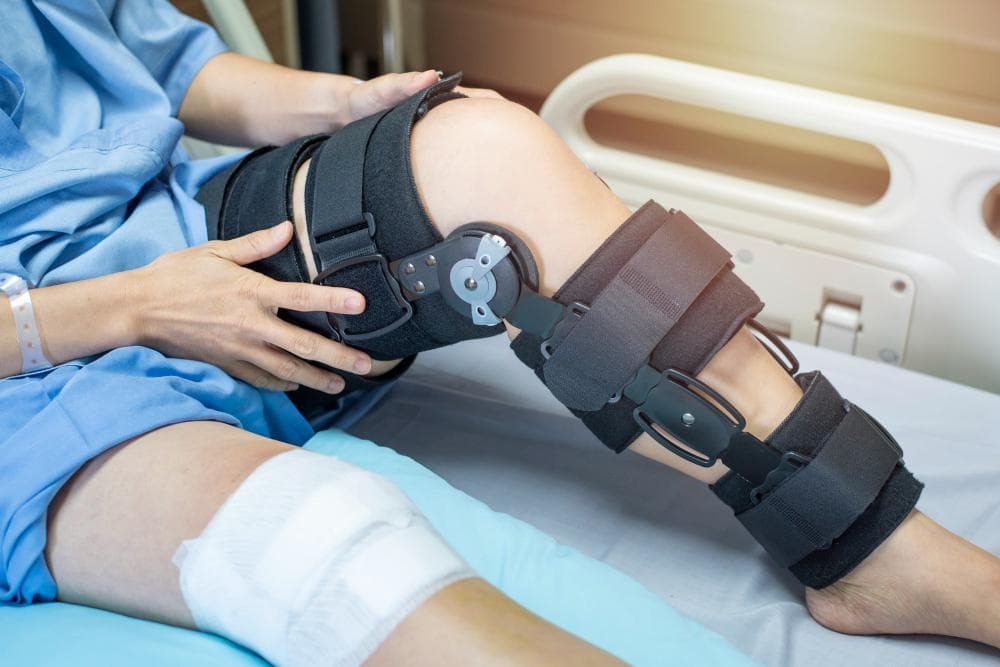
A patient is lying down in the hospital room post-surgery and is wearing a knee brace for proper recovery.
The First Hours at Home
Elevation and ice: Start immediately. Keep the limb elevated above heart level. Ice pack (wrapped in cloth) for 20 minutes every 2 hours.
Pain medication: Take your first dose before the anaesthesia wears off completely — do not wait for pain to peak. The first 6–12 hours can be the most uncomfortable.
The nerve block wearing off (shoulder patients): If you had an interscalene block, you will know it is wearing off as sensation returns — usually 12–18 hours after surgery. Have your oral pain medication ready.
Light eating: Start with small, light meals. Nausea after anaesthesia is common and typically resolves within a few hours.
Rest but not immobility: Rest is important, but the physiotherapy exercises given at discharge should begin the next day. Ankle pumps, gentle quad sets, and early mobilisation all start on day one.
Frequently Asked Questions
Q1: Will I be in a lot of pain after arthroscopy?
Pain is managed with a combination of nerve block, oral medications, and ice. Most patients describe post-arthroscopy pain as manageable rather than severe — significantly less than expected. Following the medication schedule consistently makes a large difference.
Q2: Can I eat before going to the hospital on surgery day?
Only as instructed by your team. Typically: nothing by mouth from midnight, clear fluids until 2–4 hours before surgery. Eating before anaesthesia is a safety risk — do not improvise.
Q3: How long will surgery take?
45–90 minutes for most arthroscopic procedures. More complex reconstructions may take 90–120 minutes. Your surgical team will give you a specific estimate.
Q4: Is someone available for emergencies after discharge?
Yes. Dr. Akash Dubey's clinic at Gaur City 2, Greater Noida West, provides contact information for post-operative concerns.
Contact Dr. Akash Dubey — Your Bone Mechanic
Dr. Akash Dubey
MBBS (KGMU, Lucknow) | MS | DNB Ortho | FIAS | FIJR | FIFA Diploma in Football Medicine
Robotic Surgery Certified | Member, AOPAS
Clinic: Shop No. 24, Ground Floor, Gaur City Arcade, Near Sarvodaya Hospital, Gaur City 2, Greater Noida West, U.P. – 201301
To book arthroscopy or a pre-surgical consultation in Greater Noida, call +91-8130441429